


VMS-style Cu-Zn project of roughly 215.3 km² in Central Norway.
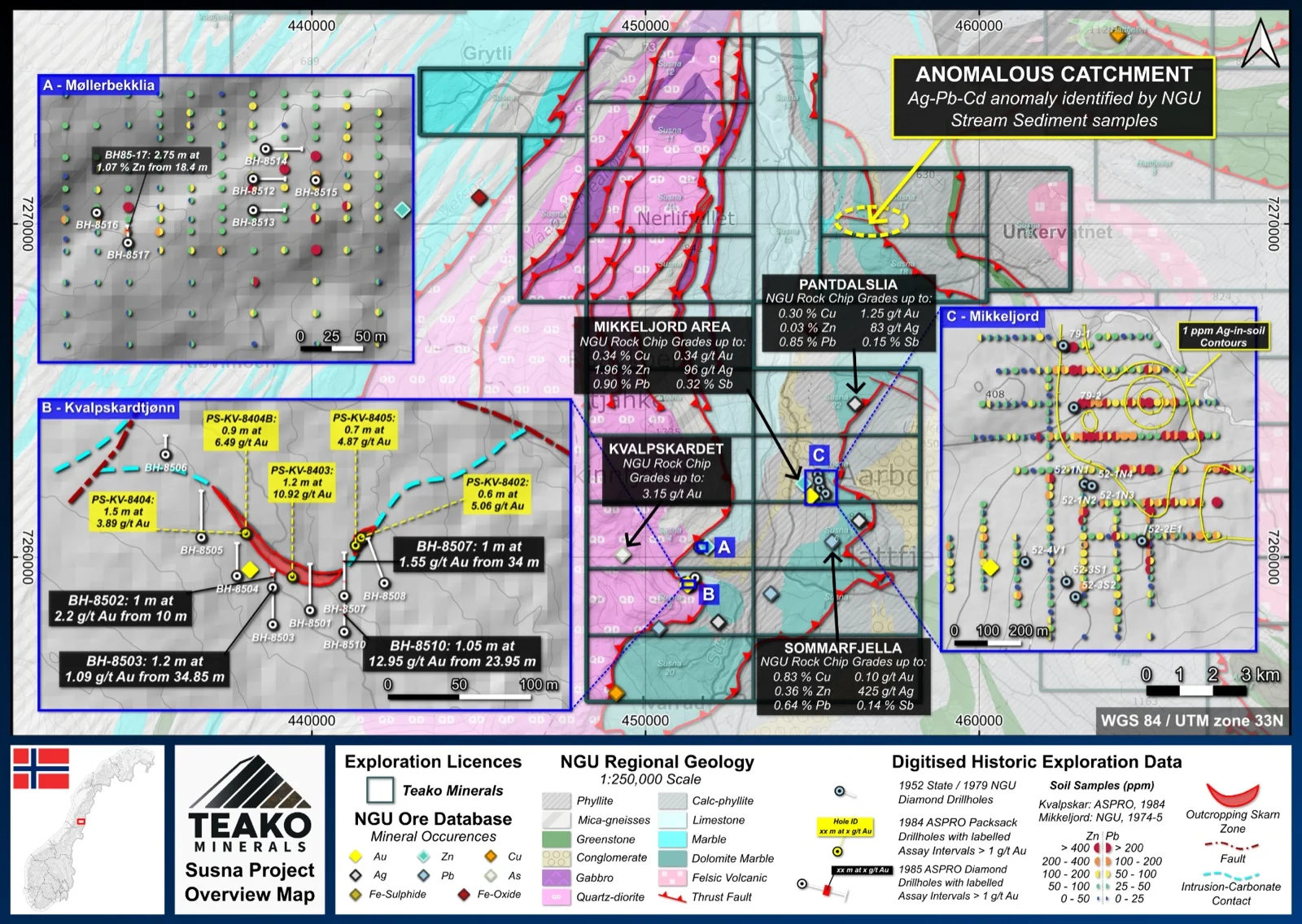
The 100% owned Susna Project is one of the larger parts of the Hatffjelldal Project cluster held by Teako Minerals AS. Located within the Hattfjelldal Municipality of Nordland County, Norway, covering a total of ~215 km2. The Project is split by the north-south trending Susna river, dividing the mountainous west from the generally lower-lying east. The Hattfjelldal Airport is located just within the northern boundary of the project area, and the regionally significant port at Mo I Rana is located ~120 km by road. Geologically the project spans over the tectonic boundary between the Helgeland and Köli Nappe complexes.
Several styles of base and/or precious metal mineralization have been identified during historic exploration across the project area, including Sediment-hosted Zn-Pb, Skarn Au and hydrothermal quartz veins. In the 1980s diamond drilling at the Kvalpskar Skarn indicated the potential for high-grade Au mineralization.
Skarn and vein-style mineralization in this district are potentially genetically linked to a phase of Caledonian felsic intrusives, which are targets for large-scale intrusion-related systems like Porphyry Cu-Mo. Exploration at Susna will aim to prospect for promising structural corridors along which veins and/or intrusions may have emplaced. The initial search space can be reduced using topographic and geophysical data to pick areas with potential dense structural complexity. Known mineral occurrences provide excellent type-localities to guide further exploration, and within their own right remain valid targets to investigate within this new mineral systems approach.
{{fig:1}}
1Teako has not performed sufficient work to verify the published data reported above, but the Company believes this information to be considered reliable and relevant. Results reported are maximum values and may not be representative of all samples collected within the area being evaluated
2References made to nearby mines and analogous deposits provide context for the regional targets but are not necessarily indicative that these targets host similar tonnages or grades of mineralization.
References
References to the ‘NGU’ regard the ‘Norwegian Geological Survey’, in particular, their Resource Database and are consolidated under this citation for simplicity. For all data sourced from this resource, please refer to: https://geo.ngu.no/kart/mineralressurser_mobil/?lang=eng
Exploration-stage project. Any historical production, grades or estimates quoted in project descriptions are historical in nature, have not been verified by the Company as current mineral resources or reserves, and should not be relied upon. See the cautionary statements and the Qualified Person statement.