


VMS-style Cu-Zn project of roughly 92.9 km² in Central Norway.
Kvittinden & Greipfjellet Projects
Kvittinden Project
The Kvittinden Project is a polymetallic target opportunity located in Nordland County, Norway. The Project consists of 27 license claims (covering 220 km2) and benefits from excellent regional infrastructure, including established forestry and access roads, proximity to a local airport, and connectivity to a deep-water port and regional airport in Mosjøen. Kvittinden sits within highly prospective metasedimentary and metavolcanic rocks, which host multiple styles of mineralization, including volcanogenic massive sulphide (”VMS”), Mississippi Valley-Type (”MVT”), and skarn mineralization.
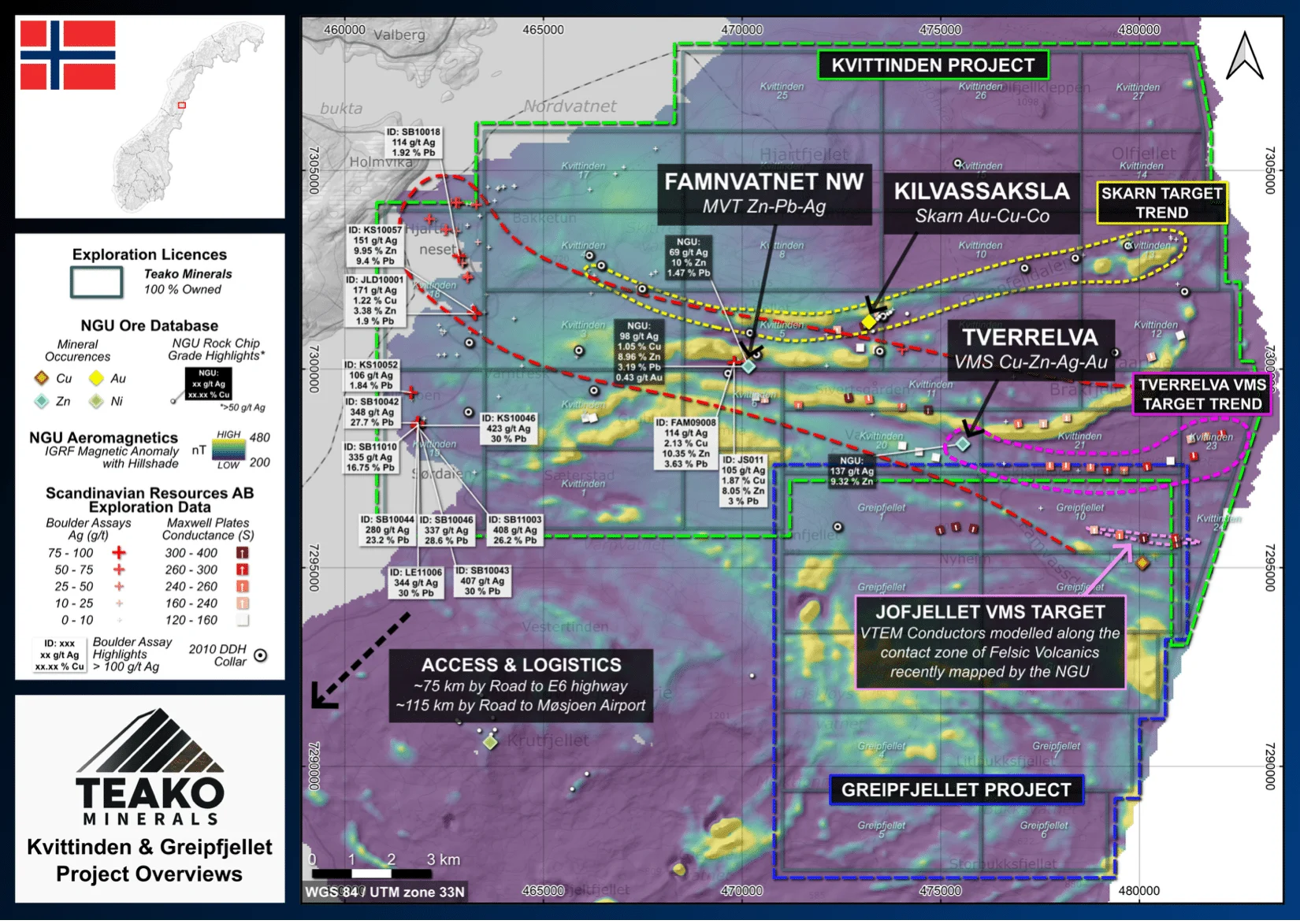
Historical exploration by major Scandinavian mining groups including Boliden and LKAB identified high-grade mineralized boulders across the property (see Figure 1) with maximum silver-lead grades of 423 g/t Ag and 30% Pb (Lilljequist, 2014)1. The NGU also sampled outcrops in the area which have presented grades to 132 g/t Ag and up to 10 % Zn, highlighting the polymetallic nature of this area1. The mineralized boulder locations are consistent with ice flow directions and extend over approximately 10 km, suggesting the presence of a significant undiscovered bedrock source (Acosta-Gongora et al., 2024) with mineralized horizons at Tverrelva (up to 9.3 % Zn)1 being strong source candidates.
More recent work by Scandinavian Resources advanced the understanding of the region through airborne electromagnetic (“VTEM”) and magnetic surveys alongside diamond drilling campaigns (Forslund, 2011, Hannans, 2012). Teako has since acquired and reprocessed the VTEM dataset using modern Maxwell plate modelling, significantly refining the project’s drill targeting capability with identification and assessment of 49 conductive Maxwell plates. Of these, 15 occur within prospective greenstones along the Tverrelva trend and are considered high-priority VMS targets. With strong infrastructure, compelling historical exploration results, modern geophysical targeting, and district-scale polymetallic potential, the Kvittinden Project represents a highly prospective exploration asset within Norway’s emerging critical minerals sector.
Greipfjellet Project
The Greipfjellet Project is also located in Nordland County, Norway. The Project consists of 10 license claims (covering 92 km2) and also benefits from excellent regional infrastructure, including local roads, airport access, and proximity to a deep-water port in Mosjøen (see Figure 1). Previous work includes a VTEM airborne geophysical survey completed by Scandinavian Resources AB in 2010 and regional till sampling conducted by the NGU. Teako has acquired and reprocessed the historical VTEM dataset to improve target definition and refine exploration priorities. Maxwell plate modelling by Geotech Airborne Ltd identified 49 conductive plates across the area many of which reside in the Greipfjellet licence area, several of which are located within prospective greenstone and felsic volcanic units considered favourable for VMS mineralization. These targets represent priority areas for future exploration and possible drill testing.
Geologically, the project area is composed primarily of rocks known to host base metal mineralization and similarities have been drawn with deposits such as Stekenjokk in Sweden and Bathurst in Canada. Geological and FDEM geophysical trends highlight indications that prospective geology may extend from the Swedish border hosting the Stekenjokk deposit into the Greipfjellet licences. Work undertaken by the NGU (Acosta 2024) has highlighted prospectivity across this region, with prospectivity for both precious and base metals noted across the licence area.
{{fig:1}}
1Teako has not performed sufficient work to verify the published data reported above, but the Company believes this information to be considered reliable and relevant. Results reported are maximum values and may not be representative of all samples collected within the area being evaluated
2References made to nearby mines and analogous deposits provide context for the regional targets but are not necessarily indicative that these targets host similar tonnages or grades of mineralization.
Exploration-stage project. Any historical production, grades or estimates quoted in project descriptions are historical in nature, have not been verified by the Company as current mineral resources or reserves, and should not be relied upon. See the cautionary statements and the Qualified Person statement.