


VMS-style Cu-Zn project of roughly 45.0 km² in Central Norway.
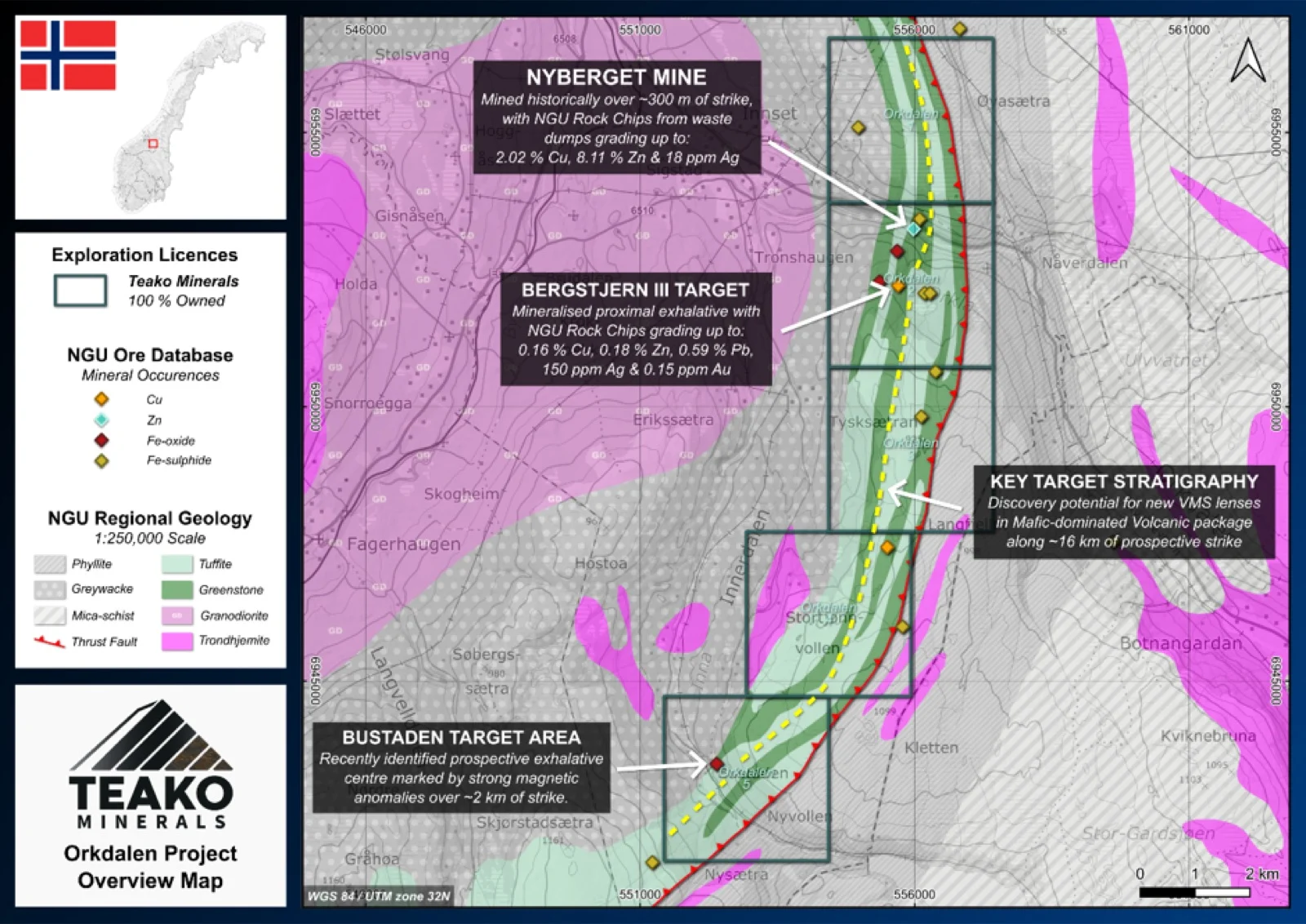
The 100% owned Orkdalen Project covers 45 km2 of a promising segment of a prospective greenstone belt, close to the E6 highway between Oppdal and Berkåk. The project covers the historical Nyberget Mine, which saw intermittent Copper production from the 17th to 19th Century, worked over a strike length of ~300 m (Nilsen, 1978). The massive sulphide ore at Nyberget is hosted by a sequence of greenstones and greenschists, punctuated by layers of quartz-magnetite ± pyrite cherts, thought to represent prospective exhalative marker horizons for VMS-style mineralization (Peter, 2003; Grenne and Slack, 2005; Hollis et al., 2021). NGU Rock chip samples from the waste dumps at the Nyberget Mine grade up to 2.02 % Cu, 8.11 % Zn and 18 ppm Ag (NGU, 2025)1.
Recent exploration over the project area saw the identification of several priority targets, including mineralized outcrops and electromagnetic conductors along strike of the Nyberget Mine and the greenfields Bustaden Target, where a previously unmapped exhalative centre was discovered. Exploration at the Orkdalen Project should seek to advance both near-mine and greenfields targets to a drill ready stage utilizing ground geophysics, supported by detailed geological mapping and sampling to constrain potential alteration haloes.
{{fig:1}}
1Teako has not performed sufficient work to verify the published data reported above, but the Company believes this information to be considered reliable and relevant. Results reported are maximum values and may not be representative of all samples collected within the area being evaluated
2References made to nearby mines and analogous deposits provide context for the regional targets but are not necessarily indicative that these targets host similar tonnages or grades of mineralization.
References
Grenne, T. and Slack, J.F. (2005) ‘Geochemistry of Jasper Beds from the Ordovician Løkken Ophiolite, Norway: Origin of Proximal and Distal Siliceous Exhalites’, Economic Geology, 100, pp. 1511–1527.
Hollis, S.P. et al. (2021) ‘Lithogeochemical and Hyperspectral Halos to Ag-Zn-Au Mineralization at Nimbus in the Eastern Goldfields Superterrane, Western Australia’, Minerals, 11(3), p. 254. Available at: https://doi.org/10.3390/min11030254.
NGU (2025) Nyberget. Mineral Resources Database Factsheet 4290. NGU. Available at: https://geo.ngu.no/api/faktaark/mineralressurser/visMetaller.php?objid=4290&lang=nor.
Nilsen, O. (1978) ‘Caledonian Sulphide Deposits and Minor Iron-formations from the Southern Trondheim Region, Norway’, NGU Bulletin, 340, pp. 35–85.
Peter, J. (2003) ‘Ancient iron formations: their genesis and use in the exploration for stratiform base metal sulphide deposits, with examples from the Bathurst Mining Camp’, Geochemistry of Sediments and Sedimentary Rocks: Evolutionary Considerations to Mineral Deposit-Forming Environments. Geological Association of Canada (Geotext, 4), pp. 145–176.
References to the ‘NGU’ regard the ‘Norwegian Geological Survey’, in particular, their Resource Database and are consolidated under this citation for simplicity. For all data sourced from this resource, please refer to: https://geo.ngu.no/kart/mineralressurser_mobil/?lang=eng
Exploration-stage project. Any historical production, grades or estimates quoted in project descriptions are historical in nature, have not been verified by the Company as current mineral resources or reserves, and should not be relied upon. See the cautionary statements and the Qualified Person statement.