


VMS-style Cu-Zn project of roughly 29.7 km² in Central Norway.
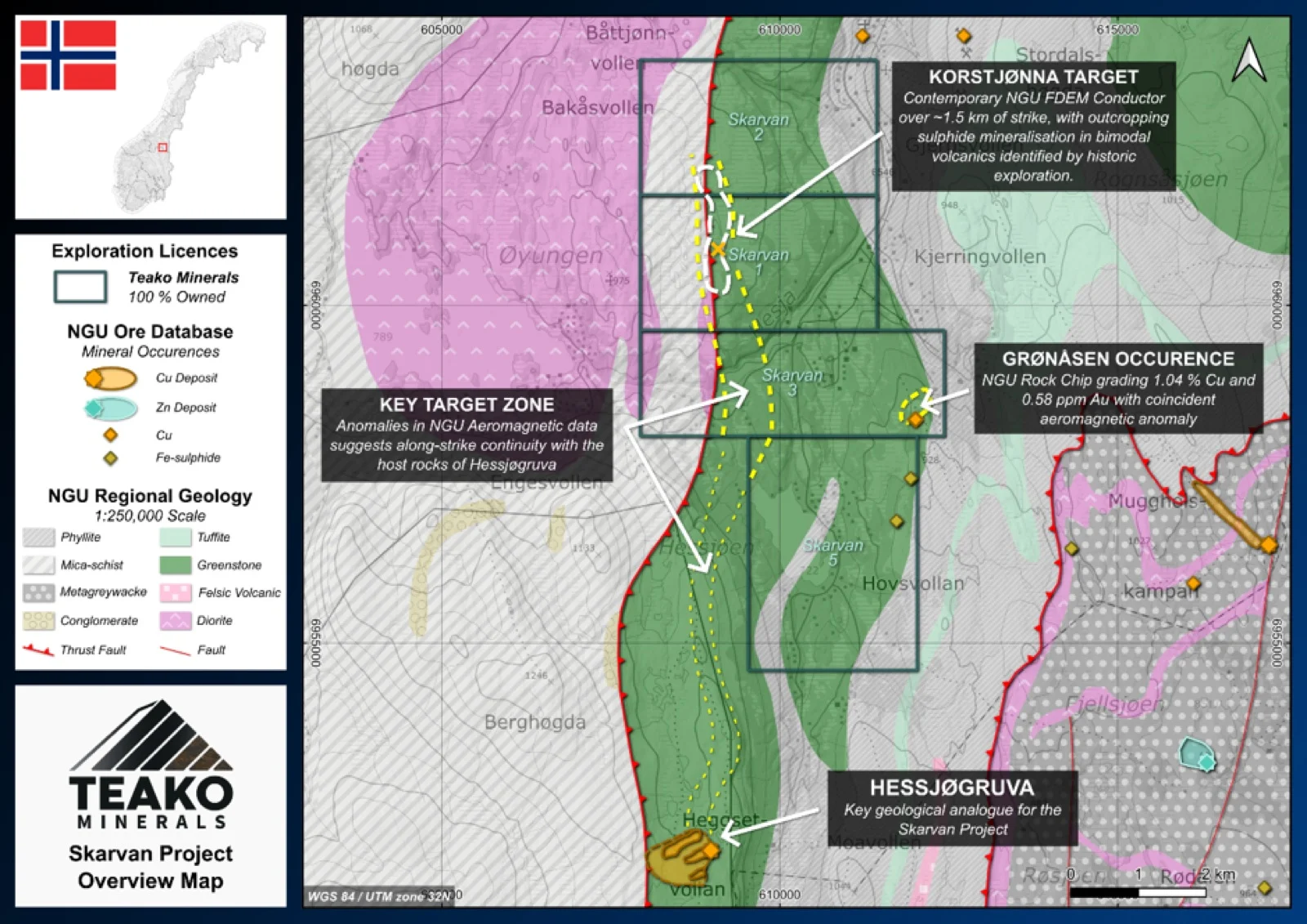
The 100% owned Skarvan project is located in the northern part of the historic Røros copper mining district in Trøndelag County, central Norway. Encompassing four contiguous claims that total 30 square kilometers. It is highly accessible via major Norwegian transport routes, including the Trondheim-Oslo highway (E6) and highways 3 and 31, and is strategically situated near both Trondheim International Airport and Røros Airport, as well as the Orkanger Deepwater Port. Geologically, Skarvan comprises rocks of the Eastern Trondheim District (ETD) greenstone belt. This specific belt is renowned for hosting syn-volcanic, stratiform zinc-copper-iron sulphide deposits, supporting more than 20 operating mines from the mid-seventeenth century until 1986 (Grenne 1987). The project hosts three known mineral occurrences—Grønåsen, Grønåshøgda I, and Grønåshøgda III.
The strategic value of Skarvan is further underscored by its proximity to significant historical deposits. The claims sit within the exact same stratigraphy and along strike of the Hessjøgruva copper-rich massive sulfide deposit, which lies just under 5 kilometers to the southwest and features multiple ore lenses extending over 1.5 kilometers (Bjerkgård 2007)2. The Skarvan area shares the same stratigraphy along strike indicating the potential to discover comparable mineralization.
While the broader Røros district has seen centuries of exploration, the specific Skarvan claims remain relatively underexplored.
In 1958, detailed mapping around Øyungen lake by Killingdal Grubeselskab identified numerous extensive graphite horizons (Johs 1959). Later, a 1975 helicopter-based magnetic and electromagnetic (EM) survey by NGU and A/S Sydvaranger revealed two strong, northwest-southeast oriented conductive zones across the Skarvan area (Håbrekke 1975). An extensive 1976 regional survey further identified 20 conductive zones enriched in copper, zinc, and nickel across the greenstone belt, with four of these key anomalous zones located directly within the Skarvan claims (Gvein 1976). Recent desktop studies by the Teako team have confirmed that minor geochemical anomalies from these 1976 stream surveys overlap with the 1975 EM anomalies, while another weak geochemical anomaly overlaps with recorded base metal occurrences, establishing clear priority targets for immediate assessment.
{{fig:1}}
1Teako has not performed sufficient work to verify the published data reported above, but the Company believes this information to be considered reliable and relevant. Results reported are maximum values and may not be representative of all samples collected within the area being evaluated
2References made to nearby mines and analogous deposits provide context for the regional targets but are not necessarily indicative that these targets host similar tonnages or grades of mineralization.
References
Grenne, T. 1987: Marginal basin type metavolcanites of the Hersje Formation, eastern Trondheim District, Central Norwegian Caledonides. Nor. geol. unders. Bull. 412, 29-42
Terje Bjerkgård 2007: The Hersjø ore deposit, evaluation of ore potential. NGU Report 2007.23
Johns Færden 1959, Killingdal Grubeselskab. Rapport fra geologisk kartlegging sommeren 1958 BV1089
Håbrekke, Henrik, Magnetiske og elektromagnetiske målinger fra helikopter over Harsjøfeltet. BV160
Gvein 1976: A/S Sydvaranger. Oppfølging av geofysiske og geokjemiske anomalier i grønnsteinsbeltet. Kartblad Dalsbygda. Sør-Trøndelag og Hedmark fylke. BV79
References to the ‘NGU’ regard the ‘Norwegian Geological Survey’, in particular, their Resource Database and are consolidated under this citation for simplicity. For all data sourced from this resource, please refer to: https://geo.ngu.no/kart/mineralressurser_mobil/?lang=eng
Exploration-stage project. Any historical production, grades or estimates quoted in project descriptions are historical in nature, have not been verified by the Company as current mineral resources or reserves, and should not be relied upon. See the cautionary statements and the Qualified Person statement.