


VMS-style Cu-Zn project of roughly 90.1 km² in Southern Norway.
Alvdal Project Overview
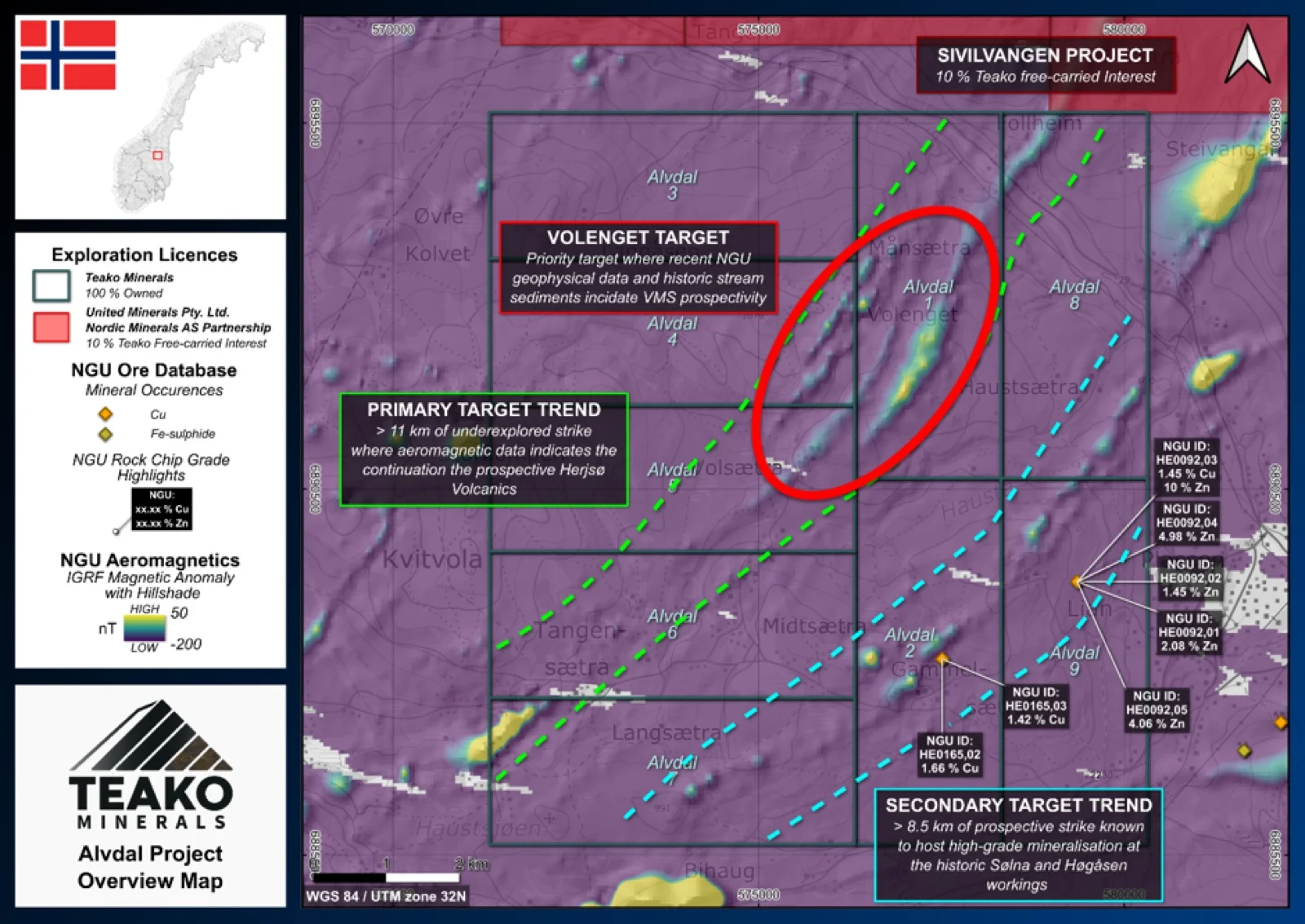
The Alvdal Project is 100% owned by Teako and represents a highly prospective greenfields exploration opportunity covering 90 km² across nine claims in the Alvdal Municipality of Innlandet County, Norway. Serving as a southern analogue to the nearby 100% Teako owned Tynset Project, Alvdal secures a compelling segment of the Hersjø Volcanics, a regionally significant target package for Cu-Zn Volcanogenic Massive Sulphide (VMS) deposits.
VMS mineralization in the Norwegian Caledonides is genetically linked to volcanism within extensional rift paleo-basins. Exploration at Alvdal focuses on identifying localized volcanic centres – indicated by proximal felsic facies or synvolcanic intrusives – which historically acted as structural conduits for hydrothermal, mineralizing fluids (Gibson et al., 2007). Recently published 2025 NGU aerogeophysical data (Dumais et al., 2025) supports the continuation of the prospective Hersjø volcanics southward into the Alvdal project area.
{{fig:1}}
Primary & Secondary Targets
Geophysics over the primary Volenget target reveal three distinct magnetic trends—Southeastern, Central, and Northwestern—indicating potential volcanic-dominated segments of the paleo-basin.
The Northwestern trend is notably distinguished by a strong K-Th-U radiometric anomaly, separating it geophysically from the other horizons.
Historical stream sediment surveys across the Volenget catchment area report elevated geochemical grades supporting VMS prospectivity, with maximum values reaching 72 ppm Cu, 97 ppm Zn, and 33 ppm Pb (Krog, 1969)1.
Located approximately 2.8 km southeast of the primary trend, a secondary parallel corridor hosts the historic Hogåsen and Sølna copper-zinc occurrences2.
NGU sampling at these secondary targets underscores their potential: the Hogåsen occurrence has returned rock sample grades up to 1.66% Cu, while the Sølna occurrence has yielded impressive grades of up to >10% Zn and 1.45% Cu (NGU ore database)1. Situated in the distinct Hummelfjell Nappe, this trend provides an additional ~8 km of prospective strike length for exploration.
1Teako has not performed sufficient work to verify the published data reported above, but the Company believes this information to be considered reliable and relevant. Results reported are maximum values and may not be representative of all samples collected within the area being evaluated
2References made to nearby mines and analogous deposits provide context for the regional targets but are not necessarily indicative that these targets host similar tonnages or grades of mineralization.
References
Dumais, M.-A. et al. (2025) Helicopter-borne magnetic, electro-magnetic and radiometric geophysical survey in Tynset area, Innlandet and Trøndelag Counties. NGU Report 2025.007. Trondheim: NGU, p. 32.
Gibson, H.L. et al. (2007) ‘The VMS Model: Advances and Application to Exploration Targeting’, Proceedings of Exploration 07. Fifth Decennial International Conference on Mineral Exploration, p. 713+730.
Krog, R. (1969) BV2922 – Geokjemiske undersokelser Haustsjoen V, Kvikne VI. NGU Report 829. Trondheim: NGU, Folldal Verk AS, p. 22.
References to the ‘NGU’ regard the ‘Norwegian Geological Survey’, in particular, their Resource Database and are consolidated under this citation for simplicity. For all data sourced from this resource, please refer to: https://geo.ngu.no/kart/mineralressurser_mobil/?lang=eng
Exploration-stage project. Any historical production, grades or estimates quoted in project descriptions are historical in nature, have not been verified by the Company as current mineral resources or reserves, and should not be relied upon. See the cautionary statements and the Qualified Person statement.