


VANCOUVER, B.C. | August 18, 2026 | Teako Minerals Corp. (CSE: TMIN) (the “Company” or “Teako”) is pleased to announce the commencement of its 2026 field program at the Tynset copper-zinc-silver (“Cu-Zn-Ag”) volcanogenic massive sulphide (“VMS”) project in central Norway. The current field program will include additional geological mapping and sampling, together with an Induced Polarization (“IP”) geophysical survey, designed to build upon the Company’s existing datasets and produce refined and high-priority drill targets within the Storbekken Priority 1 target area. The Company currently expects first diamond drill testing of priority targets at Tynset in Q4 2026-Q1 2027.
The Company also announces that it has expanded the Tynset Project through the staking and granting of four additional exploration licences covering the high-priority Nonsvola and Vingelen target areas (see Figure 1) thus expanding the strike length of the prospective volcanic belt.
Highlights
- Teako commences field program at the high-grade Tynset copper-zinc-silver (“Cu-Zn-Ag”) volcanogenic massive sulphide (“VMS”) project in central Norway. The current work program is designed to refine drill targets for testing on a priority basis in Q4 2026-Q1 2027.
- Tynset Project has been expanded through the staking and granting of four additional exploration licences covering the high-priority Nonsvola and Vingelen target areas (see Figure 1) thus expanding the strike length of the prospective volcanic belt.
- Geovisor Oy has been engaged to complete approximately 10 line kilometres of IP surveying across the Storbekken Priority 1 target area (see Figure 1) commencing mid October 2026.
About Field Program and Induced Polarization Survey
The 2026 field program at the Tynset Project will consist of i) detailed geological and structural mapping, together with systematic outcrop sampling for geochemical and spectral laboratory analysis (the “Field Program”), and ii) an IP geophysical survey covering the most prospective stratigraphy for high-grade VMS-style mineralization. The Field Program is designed to refine the positions of key lithological contacts and better characterize known mineralized and altered outcrops through geochemistry and spectral data. The collection of structural data along the planned IP survey lines will also improve the interpretation of the geophysical results. The Company will prioritize the resistivity and chargeability features which can be tied to the most promising surface geology, to improve the probability of successfully drilling a copper-rich VMS system.
Geological and structural mapping will be completed along the IP survey lines (see Figure 1), around known mineral occurrences and across areas of historical soil anomalism. Structural measurements will be collected using a consistent methodology to support the development of an improved three-dimensional geological interpretation and assist with the interpretation of geophysical data, historical drilling and future drill results.
Sampling will include mineralized material, representative whole-rock characterization samples and samples selected for spectral analysis. The resulting geological, structural, geochemical and spectral datasets are intended to improve the Company’s understanding of alteration patterns, mineralized trends and subsurface geometry.
A critical outcome for the IP survey can be directly linked to the known geology at Storbekken, where thick packages of felsic volcanic rocks, interpreted to have been altered to quartz-sericite schists, contain variable quantities of disseminated pyrite. The IP survey is expected to help delineate the subsurface geometry and electrical response of these zones, with elevated resistivity potentially associated with the high quartz content and chargeability responses potentially reflecting disseminated sulphides. Comparing surface geological, geochemical and alteration data on these zones with the IP profiles will assist with identifying areas where favourable geophysical responses coincide with the most intense and prospective alteration, helping to vector towards a potential prospective core of the hydrothermal system and guide drill targeting. Contact zones between felsic volcanic rocks and graphitic schists could be highly prospective target horizons, marking a sea-floor interface on which exhalative VMS mineralization may have originally formed. An example is seen at the Stekenjokk deposit in Sweden, a key analogue for the Tynset project. Priority drill targets will be defined where promising IP responses correlate with prospective surface geology, combining geophysical, geological and geochemical datasets to ensure that drilling tests the most promising areas of the Storbekken target.
Details of the IP Survey
The Company has engaged Geovisor Oy to complete approximately 10 line kilometers of IP surveying across the Storbekken Priority 1 target area (see Figure 1) scheduled for mid October 2026. The resulting IP dataset is expected to provide the principal three-dimensional geophysical framework for refined drill targeting to an anticipated depth of 200-350 metres, with priority anomalies identified and interpreted from each surveyed profile.
Surface geological observations and laboratory results from the Field Program will be incorporated into the IP sections, allowing the inverted geophysical responses to be compared directly with mapped lithological contacts, alteration, mineralization and structural features. This integrated interpretation is intended to improve the geological context of identified IP anomalies and support the refinement of high-priority drill targets.
About the Tynset Project
The Tynset Project is 100%-owned by the Company and is located in central Norway within the Tynset municipality, Innlandet County (see Figure 1). The Tynset Project consists of 14 granted exploration claims (covering a total area of 121 km2) that includes approximately 29 km of prospective strike length of the bimodal Hersjø Volcanic belt, which is considered to be fertile for the discovery of Cu-Zn-Ag VMS systems (Grenne, Vokes and Ihlen, 1999). The Project benefits from established infrastructure, including a railway line running along the Project’s eastern boundary that connects to the deep-sea ports in the Trondheim area. The Norwegian National Road 3 also crosses the Project area. The Tynset Project is contiguous to the Sivilvangen project in which the Company holds a 10% free-carried ownership interest up until final investment decision through its partnership with Nordic Minerals AS, a wholly owned subsidiary of United Minerals Australia Pty Ltd (see Company press release dated January 5, 2026). The Tynset Project is supported by a significant historical database that indicates a favourable geological setting for Cu-Zn-Ag VMS mineralization. The Tynset Project was operated by Norwegian mining company Folldal Verk A/S in the 1980s and is understood by the Company to have ceased its exploration efforts in the late 1980’s due to declining commodity prices and changes in strategic objectives.

From a geological perspective, the Tynset belt consists of a bimodal volcanic sequence (both mafic and felsic volcanic rocks), together with intercalated metasedimentary rocks (including graphitic phyllites), and local sulfide occurrences. The Company has digitized a significant amount of historical exploration data1,2 collected across the belt including i) over 1,400 soil samples (with results returning up to 470 ppm Cu and 765 ppm Zn) (Folldal Verk A/S, 1981, 1982) ii) 335 stream sediment samples (returning up to 335 ppm Cu, 1,323 ppm Zn and 47 ppm Pb) (Krog, 1968), iii) over 1,800 ground magnetometer measurements (Cuttle, 1982) and iv) 23 rock chip samples reaching up to 2.44% Cu, 30.93% Zn and 14.94% Pb (Folldal Verk A/S, 1982), with NGU samples also showing grades of up to 197.1 g/t Ag (NGU, 2015). These data are supported by recently published airborne geophysical data from the Norwegian Geological Survey (“NGU”), from which the highly prospective priority 1 target, Storbekken, has been identified. The Storbekken target shows significant Cu-Zn soil anomalism over ~5 km of strike length, coincident with hydrothermally altered and mineralized felsic volcanics. Logging data from limited historical drilling (5 holes totalling 585 m) indicate that intense hydrothermal alteration was intersected (which has been interpreted by the Company to be indicative of proximity to a hydrothermal system associated with VMS mineralization). Limited assays from historical drilling (only 30.25m for Cu and Zn) returned low grade intervals of Cu and Zn, although no assays are available for Ag. The best visual interval recorded from 45.60 to 47.40 m in diamond drill hole S-83-4 was estimated to contain 10-15% sphalerite, however no assay results are available for the interval (Bjerkgård, 1990).
With prospective geology, extensive soil anomalism, and surficial indications of both hydrothermal alteration and mineralization, Teako believes that this target has significant potential to host a new Cu-Zn-Ag VMS discovery. Outside this Storbekken priority 1 target, the Company has identified further prospective target areas within the Tynset Project. The Nonsvola target, found toward the north-east end of the project area, shows clear similarities to the Storbekken target. Base metal mineralization is recorded both in outcrop (NGU rock chip grades up to 2.60 % Cu, 4.26 % Zn and 0.49 g/t Au (NGU, 2015))2 and in historic drill core, in a sequence of altered felsic volcanics and mixed volcaniclastics that been altered to quartz-sericite and quartz-chlorite schists. Targeting is supported by strong soil anomalies (up to 1,700 ppm Zn, 200 ppm Cu and 26 ppm Pb)(Bakke and Wilberg, 1984)2, contributing to a highly prospective target ready for follow-up investigations.
Adding to the potential of the north-east end of the project area is the historic Vingelen Mine, which sits ~4.5 km north-east and along strike of the Nonsvola target. The NGU report that the mine produced an estimated 30 Kt of sulphide ore at a grade of 1.30 % Cu, with historical drilling indicating mineralization down to a depth below surface of ~210 m (NGU, 2024)3. Two subparallel ‘plates’ of sulphide mineralization were historically found at the deposit, separated by 10 m of host rock. The north plate was the thicker of the two (up to 4 m) and was the focus of historic production. In 1983 Folldal Verk AS attempted to drill through both plates at depth with a single hole, intersecting the upper plate (1.70 m at 0.81 % Cu & 2.35 % Zn from 208.80 m) but was stopped short of the lower plate as the hole was abandoned due to unusually challenging winter drilling conditions (i.e. -30 °C) (Bakke and Wilberg, 1984). The deposit is interpreted as a fold repetition of the same sulphide horizon across a tight isoclinal fold (Bjerkgård, 1989), making the potential hinge zone a priority target for the discovery of a thickened and potentially economic sulphide body. The project also covers multiple untested greenfields areas where strong aeromagnetic anomalies are interpreted by the Company to represent potential volcanic centres that may host VMS mineralization.
1,2 Teako has not performed sufficient work to verify the published data reported above, but the Company believes this information to be considered reliable and relevant. Results reported are maximum values and may not be representative of all samples collected within the area being evaluated
3 Verweise auf nahegelegene Minen und analoge Lagerstätten liefern Kontext für die regionalen Ziele, sind aber nicht notwendigerweise ein Hinweis darauf, dass diese Ziele ähnliche Tonnagen oder Gehalte an Kupfermineralisierung führen.
Qualified Persons and Disclosure Statement
The technical information presented in this news release has been prepared in accordance with Canadian regulatory requirements as set out in National Instrument 43-101 (“NI 43-101”) and approved by Eric Roth, a Director of the Company and a Qualified Person under NI 43-101. Mr. Roth holds a Ph.D. in Economic Geology from the University of Western Australia, is a Fellow of the Australian Institute of Mining and Metallurgy (AusIMM) and is a Fellow of the Society of Economic Geologists (SEG). Mr. Roth has over 35 years of experience in international minerals exploration and mining project evaluation.
References:
Bjerkgård, T. (1990) BV5641 – The Nord-Østerdalen Project 1990. Folldal Verk A/S, p. 27.
Cuttle, J. (1982) BV3093 – Folldal Project 1982 Maps. Map Appendices N-81-1. FolldalVerk A/S, Amoco Norway Oil Company.
Folldal Verk A/S (1981) BV3091 – Folldal Project 1981 Maps. Map Appendices N-81-1. Folldal Verk A/S, Amoco Norway Oil Company.
Folldal Verk A/S (1982) ‘BV4176 – Geokjemi 1982, Folldal prosjekt.’ Folldal Verk A/S.
Krog, R. (1968) BV2925 – Geokjemiske undersokelser: Grimsdalen III, Savalen IV. NGU Report 760. Trondheim: NGU, Folldal Verk AS.
Bakke, O. and Wilberg, R. (1984) FOLLDAL PROJECT (N-81-1): 1983 Summary. Annual Report BV3096. Folldal Verk A/S, Amoco Norway Oil Company, p. 66.
Bjerkgård, T. (1989) Regionalgeologiske Undersøkelser i Vingelenfeltet, Nord-Østerdalen, i det sørlige Trondheimsfeltet, med henblikk på sulfidmineraliseringene. Cand. scient. oppgave. Universitetet i Oslo.
Grenne, T., Vokes, F.M. and Ihlen, P.M. (1999) ‘Scandinavian Caledonide Metallogeny in a plate tectonic perspective’, Mineralium Deposita, 34, pp. 422–471.
References to the NGU Resource Database are consolidated under this citation for simplicity. For all data sourced from this resource, please refer to: https://geo.ngu.no/kart/mineralressurser_mobil/?lang=eng
About Teako Minerals Corp.:
Teako Minerals Corp. is a Vancouver-based mineral exploration company committed to acquiring, exploring, and developing mineral properties in Norway, focusing on critical metals such as copper and zinc in massive sulfides. By leveraging leading-edge exploration technologies and strategic partnerships, Teako aims to address the growing demand for essential minerals while generating value for shareholders and stakeholders alike.
Teako, within its Norwegian Project Hub owns over 60 projects 100% and holds a 10% economic interest in the four (4) rare earth elements ("REE") projects owned by Fritzøe Skoger AS and a 10% non-dilutive free carried ownership interest in five (5) copper, gold and silver projects owned by Nordic Minerals AS, a wholly owned subsidiary of United Minerals Australia Pty Ltd as further described on the Company’s website.
Teako’s Project Hub, including the Tynset, Venna and Løkken main projects, covers an extensive land package prospective for copper, cobalt, zinc, gold, silver, platinum group elements (or "PGE"), uranium, antimony, molybdenum, tungsten and rare-earth-elements. The Project Hub strategy was initially developed from the Company’s first-mover advantage in-country, leveraging both technical skill and strong local community engagement to acquire and advance groups of both core and non-core assets. Core assets such as the Løkken, Venna and Tynset projects remain integral to the Company’s self-funded exploration programs, whereas the Company aims to retain exposure to exploration success on non-core assets through securing deals with strong partners. These deals, if secured, are intended to potentially bring in capital and/or ongoing cash flow, retain upside exposure, and reduce overall risk, thereby strengthening Teako’s foundation.
Contact Information:
Sven Gollan – CEO
T: +1 (604)-871-4301
Email: sven.gollan@teakominerals.com
Forward-Looking Information:
This press release may include forward-looking information within the meaning of Canadian securities legislation, concerning the business of Teako. Forward-looking information is based on certain key expectations and assumptions made by the management of Teako. In some cases, you can identify forward-looking statements by the use of words such as “will,” “may,” “would,” “expect,” “intend,” “plan,” “seek,” “anticipate,” “believe,” “estimate,” “predict,” “potential,” “continue,” “likely,” “could” and variations of these terms and similar expressions, or the negative of these terms or similar expressions. Forward-looking statements in this press release include statements related to timing of the expected drill program and IP survey at the Tynset project and the Company’s business plans and operations and other matters. Although Teako believes that the expectations and assumptions on which such forward-looking information is based are reasonable, undue reliance should not be placed on the forward-looking information because Teako can give no assurance that they will prove to be correct. Since forward-looking statements address future events and conditions, by their very nature, they involve inherent risks and uncertainties. Actual results could differ materially from those currently anticipated due to a number of factors and risks. These include but are not limited to, risks associated with the mineral exploration industry in general (e.g., operational risks in development, exploration and production; the uncertainty of mineral resource estimates; the uncertainty of estimates and projections relating to production, costs and expenses, and health, safety and environmental risks), constraint in the availability of services, commodity price and exchange rate fluctuations, changes in legislation impacting the mining industry, adverse weather conditions and uncertainties resulting from potential delays or changes in plans with respect to exploration or development projects or capital expenditures. These and other risks are set out in more detail in Teako’s interim Management’s Discussion and Analysis, for the period ended January 31, 2026.
All dollar figures included herein are presented in Canadian dollars, unless otherwise noted. Neither the CSE nor its market regulator accepts responsibility for the adequacy or accuracy of this press release.
VANCOUVER, B.C. | April 21, 2026 | Teako Minerals Corp. (CSE: TMIN) (the “Company” or “Teako”) is pleased to announce the addition of the 100%-owned Tynset copper-zinc-silver (”Cu-Zn-Ag”) volcanogenic massive sulfide (”VMS”) Project to the Company’s core project portfolio in central Norway, which also includes the Løkken-Venna VMS district. The Tynset Project was acquired by the Company through staking and represents a high-priority and advanced-stage exploration target supported by a substantial amount of historical and recently published geological data that collectively indicate a favourable geological setting for Cu-Zn-Ag VMS deposits.
The Company currently expects drill target definition work at the Tynset Project to be completed in mid-2026, with the initial diamond drill testing of priority targets to be undertaken during H2 2026.
Highlights
- The 100%-owned Tynset Project was acquired by the Company through staking and represents a high-priority and advanced-stage exploration target covering approximately 19 km of prospective stratigraphy in the bimodal Hersjø Volcanic belt for the discovery of Cu-Zn-Ag VMS deposits.
- A significant database of both historical and recently published geological data exists and supports the concept of the Tynset Project being a favourable geological setting for VMS-style Cu-Zn-Ag mineralization.
- The Company has already digitized a significant amount of the available historical exploration data collected across the belt, including 1,400 soil and 23 rock chip samples, 335 stream sediment samples, and 1,800 ground magnetometer readings. These results have allowed for the definition of priority areas for immediate follow-up field review.
- Recently published airborne geophysical data from the Norwegian Geological Survey indicates areas of magnetic highs which are interpreted by the Company to represent potential volcanic centres, with a priority 1 target “Storbekken” having already been identified.
- The Storbekken target also shows significant Cu-Zn soil anomalism over ~5 km of strike length, coincident with hydrothermally altered and mineralized felsic volcanics.
- The next steps for the Tynset Project will be drill target definition activities, including structural mapping, outcrop sampling, an Induced Polarization (“IP”) geophysical survey followed by initial diamond drilling on priority targets.
About the Tynset Project:
The Tynset Project is 100%-owned by the Company and is located in central Norway within the Tynset municipality, Innlandet County. The Tynset Project consists of 10 granted exploration claims (covering a total area of 88 km2) that covers approximately 19 km of prospective strike length of the bimodal Hersjø Volcanic belt, which is considered to be fertile for the development of Cu-Zn-Ag VMS systems (see Figure 1). The Project benefits from established infrastructure, including a railway line running along the Project's eastern boundary that connects to the deep-sea ports in the Trondheim area. The Norwegian National Road 3 also crosses the Project area. The Tynset Project is contiguous to the Sivilvangen project in which the Company holds a 10% free-carried ownership interest up until final investment decision through its partnership with Nordic Minerals AS, a wholly owned subsidiary of United Minerals Australia Pty Ltd (see Company press release dated January 5, 2026).

The Tynset Project is supported by a significant historical database that indicates a favourable geological setting for Cu-Zn- Ag VMS mineralization. The Tynset Project was operated by Norwegian mining company Folldal Verk A/S in the 1980s and is understood by the Company to have ceased its exploration efforts in the late 1980’s due to declining commodity prices and changes in strategic objectives.
From a geological perspective, the Tynset belt consists of a bimodal volcanic sequence (both mafic and felsic volcanic rocks), together with intercalated metasedimentary rocks (including graphitic phyllites), and local sulfide occurrences. The Company has digitized a significant amount of historical exploration data1 collected across the belt including i) over 1,400 soil samples (with results returning up to 470 ppm Cu and 765 ppm Zn) (Folldal Verk A/S, 1981, 1982) ii) 335 stream sediment samples (returning up to 335 ppm Cu, 1,323 ppm Zn and 47 ppm Pb) (Krog, 1968), iii) over 1,800 ground magnetometer measurements (Cuttle, 1982) and iv) 23 rock chip samples reaching up to 2.44% Cu, 30.93% Zn and 14.94% Pb (Folldal Verk A/S, 1982), with NGU samples also showing grades of up to 197.1 g/t Ag (NGU, 2015).
These data are supported by recently published airborne geophysical data from the Norwegian Geological Survey (“NGU”), from which a highly prospective priority 1 target, Storbekken, has been identified (Figure 1). The Storbekken target shows significant Cu-Zn soil anomalism over ~5 km of strike length, coincident with hydrothermally altered and mineralized felsic volcanics. Logging data from limited historical drilling (5 holes totalling 585 m) indicate that intense hydrothermal alteration was intersected (which has been interpreted by the Company to be indicative of proximity to a hydrothermal system associated with VMS mineralization). Limited assays from historical drilling (only 30.25m of core were analyzed, and solely for Cu and Zn) returned low grade intervals of Cu and Zn, although no assays are available for Ag. The best visual interval recorded from 45.60 to 47.40 m in diamond drill hole S-83-4 was estimated to contain 10-15% sphalerite, however it was not assayed (Bjerkgård, 1990).
With prospective geology, extensive soil anomalism, and surficial indications of both hydrothermal alteration and mineralization, Teako believes that this target has significant potential to host a new Cu-Zn-Ag VMS discovery. Outside this Storbekken priority 1 target, the Company has identified further prospective target areas within the Tynset Project where strong aeromagnetic anomalies are interpreted by the Company to represent potential volcanic centres that may host VMS mineralization.
Historical geochemical data reported are sourced from: i) Bjerkgård, T. (1990) BV5641 – The Nord-Østerdalen Project 1990. Folldal Verk A/S, p. 27. ii) Cuttle, J. (1982) BV3093 – Folldal Project 1982 Maps. Map Appendices N-81-1. Folldal Verk A/S, Amoco Norway Oil Company. iii) Folldal Verk A/S (1981) BV3091 – Folldal Project 1981 Maps. Map Appendices N-81-1. Folldal Verk A/S, Amoco Norway Oil Company. iv) Folldal Verk A/S (1982) ‘BV4176 – Geokjemi 1982, Folldal prosjekt.’ Folldal Verk A/S. v) Krog, R. (1968) BV2925 – Geokjemiske undersokelser: Grimsdalen III, Savalen IV. NGU Report 760. Trondheim: NGU, Folldal Verk AS. vi) NGU (2015) Bjørkåsen. Mineral Resources Database Factsheet 5629. NGU. Available at: https://geo.ngu.no/api/faktaark/mineralressurser/visImiNasOreOmr.php?objid=5629 (Accessed: 17 April 2026). Whilst the Company has not performed sufficient work to verify the geochemical data reported above, the Company believes this information to be reliable and relevant.
Next Steps
The next steps for the Tynset Project include field-based exploration activities – including structural mapping, outcrop sampling, and an Induced Polarization (“IP”) geophysical survey – with follow-up diamond drilling on priority targets currently expected to be undertaken during H2 2026.
Update on Other Core Projects
The next steps for the Venna Project include further geological mapping and systematic sampling, currently anticipated to be carried out during H2 2026. These activities will build on the positive results of the 2025 field program (see Company press release dated December 8, 2025) and are designed to refine and prioritize target areas for subsequent advanced geophysical surveys.
The Company is currently conducting a comprehensive review and evaluation of all available data, together with available options, in respect of its Løkken Project.
Qualified Persons and Disclosure Statement
The technical information presented in this news release has been prepared in accordance with Canadian regulatory requirements as set out in National Instrument 43-101 (“NI 43-101”) Standards of Disclosure for Mineral Projects, and reviewed and approved by Eric Roth, a Non-Executive Director of Teako and a Qualified Person under NI 43- 101. Mr. Roth holds a Ph.D. in Economic Geology from the University of Western Australia, is a Fellow of the Australian Institute of Mining and Metallurgy (AusIMM), and is a Fellow of the Society of Economic Geologists. Mr. Roth has over 35 years of experience in international minerals exploration and mining project evaluation.
About Teako Minerals Corp.:
Teako Minerals Corp. is a Vancouver-based mineral exploration company committed to acquiring, exploring, and developing mineral properties in Norway, focusing on critical metals such as copper and zinc in massive sulfides. By leveraging leading-edge exploration technologies and strategic partnerships, Teako aims to address the growing demand for essential minerals while generating value for shareholders and stakeholders alike.
Teako, within its Norwegian Project Hub owns 62 projects 100% and holds a 10% economic interest in the four (4) rare earth elements (“REE”) projects owned by Fritzøe Skoger AS and a 10% non-dilutive free carried ownership interest in a five (5) copper, gold and silver projects owned by Nordic Minerals AS, a wholly owned subsidiary of United Minerals Australia Pty Ltd as further described on the Company’s website.
Teako’s Project Hub, including the Løkken, Venna and Tynset main projects, covers an extensive land package prospective for copper, cobalt, zinc, gold, silver, platinum group elements (or “PGE”), uranium, antimony, molybdenum, tungsten and rare-earth-elements. The Project Hub strategy was initially developed from the Company’s first-mover advantage in- country, leveraging both technical skill and strong local community engagement to acquire and advance groups of both core and non-core assets. Core assets such as the Løkken, Venna and Tynset projects remain integral to the Company’s self- funded exploration programs, whereas the Company aims to retain exposure to exploration success on non-core assets through securing deals with strong partners. These deals, if secured, are intended to potentially bring in capital and/or ongoing cash flow, retain upside exposure, and reduce overall risk, thereby strengthening Teako’s foundation.
Contact Information:
Sven Gollan – CEO T: +1 (604)-871-4301 Email: sven.gollan@teakominerals.com
Forward-Looking Information:
This press release may include forward-looking information within the meaning of Canadian securities legislation, concerning the business of Teako. Forward-looking information is based on certain key expectations and assumptions made by the management of Teako. In some cases, you can identify forward-looking statements by the use of words such as “will,” “may,” “would,” “expect,” “intend,” “plan,” “seek,” “anticipate,” “believe,” “estimate,” “predict,” “potential,” “continue,” “likely,” “could” and variations of these terms and similar expressions, or the negative of these terms or similar expressions. Forward-looking statements in this press release include statements related to the expectations in relation to the expected exploration work and drilling, the timing of such exploration work and drilling, and the Company’s business plans and operations and other matters. Although Teako believes that the expectations and assumptions on which such forward-looking information is based are reasonable, undue reliance should not be placed on the forward-looking information because Teako can give no assurance that they will prove to be correct. Since forward-looking statements address future events and conditions, by their very nature, they involve inherent risks and uncertainties. Actual results could differ materially from those currently anticipated due to a number of factors and risks. These include but are not limited to, risks associated with the mineral exploration industry in general (e.g., operational risks in development, exploration and production; the uncertainty of mineral resource estimates; the uncertainty of estimates and projections relating to production, costs and expenses, and health, safety and environmental risks), constraint in the availability of services, commodity price and exchange rate fluctuations, changes in legislation impacting the mining industry, adverse weather conditions and uncertainties resulting from potential delays or changes in plans with respect to exploration or development projects or capital expenditures. These and other risks are set out in more detail in Teako’s interim Management’s Discussion and Analysis, for the period ended October 31, 2025.
All dollar figures included herein are presented in Canadian dollars, unless otherwise noted. Neither the CSE nor its market regulator accepts responsibility for the adequacy or accuracy of this press release.
400-601 West Broadway, Vancouver, BC, V5Z 4C2 TEL +1 (604)-871-4301 www.teakominerals.com
VANCOUVER, B.C. | December 8, 2025 | Teako Minerals Corp. (CSE: TMIN) (the “Company” or “Teako”) is pleased to report that it has received laboratory results for 61 rock chip samples taken as part of the 2025 sampling program in the Mostadmarka Target Area (or "Mostadmarka") of its 100%-owned Venna copper-cobalt-zinc ("Cu-Co-Zn") massive sulfide ("VMS") main project. Teako’s recent field review of the extensive ironworks trend within Mostadmarka and the southern magnetic trend (see Company Press Release dated November 26, 2025) determined that the formations (>20km cumulative strike length) of jasper and quartz-magnetite cherts at Mostadmarka could be interpreted as distal indicators of Cu-rich VMS deposits.
Initial interpretations of the laboratory results have resulted in (i) the identification of three high-priority VMS targets (Nævra, Heingruva, Storslåtten) within the ironworks trend (~10 km strike extent) and the southern magnetic trend (~10 km strike extent) at Mostadmarka, exhibiting indications that the iron formations at Mostadmarka formed from high temperature VMS-fertile fluids suggesting potential for buried massive sulfide mineralization in the area, (ii) a robust characterisation of the host volcanic rocks at Mostadmarka, and (iii) provided a better understanding of the geological setting of the previously identified ‘Sandsve’ high-grade Cu occurrence (SANDSVE-2 @ 2,5% Cu) situated to the west and along strike of Storslåtten at the southern magnetic trend, suggesting a potential connection to buried massive sulfide mineralization (see Figure 1).
Highlights • Three high-priority VMS targets have been identified for follow-up work: Nævra, Heingruva, and Storslåtten.
- The Nævra Target has been identified through a cluster of sulfide and trace element enriched samples over ~1.2 km within the ironworks trend, with potential indications of hydrothermal replacement at the target.
- The Heingruva Target in the ironworks trend is highlighted by four samples showing a hydrothermal exhalative composition, including two with prospective indicators of a proximal hot hydrothermal vent source.
- The Storslåtten Target in the southern magnetic trend contains geochemical and textural indicators of hydrothermal stringer veins along strike of a geophysical (airborne electromagnetic) anomaly stretching over ~2.2 km.
- The previously identified Sandsve high-grade Cu occurrence (SANDSVE-2 @ 2,5% Cu) is situated to the west and along strike of the Storslåtten Target in the southern magnetic trend, suggesting a potential connection to buried massive sulfide mineralization in the area.
The Venna Project Geochemical Results
The primary objective of this geochemical study was to investigate the extensive iron formations within the Mostadmarka ironworks trend for geochemical indications of VMS-fertile hydrothermal activity. Eighteen (18) samples were collected from ‘Oxide’ facies iron formations (e.g. Jaspers, Magnetite Cherts) and a further 11 samples were collected of ‘sulfide’ facies horizons (locally termed ‘Vasskis’). Within the Oxide group, the laboratory results have distinguished two styles of iron formation which both show promising indications. The first group is clustered on the historical Nævra Ironworks, where 11 samples over ~1.2 km of strike show elevated sulfur (up to 2.62 %), base-metal (up to 305 ppm Cu+Pb+Zn) and pathfinder element (e.g. up to 59 ppm As and 6.16 ppm Sb) concentrations indicating the influence of a prospective hydrothermal source at the Nævra Target. These 11 samples also have a notable Al2O3 content for iron formations (average 2.59 %), and comparable signatures in the literature from Kuroko, Japan and the Tyrone Igneous Complex, Northern Ireland, suggest formation via hydrothermal replacement over exhalative processes (Hollis et al., 2015). In long-lived hydrothermal systems, replacement-style processes can be favourable for both higher grade and larger tonnage sulfide deposits (Piercey, 2015). Future studies at Venna will aim to screen for textural indications of replacement processes at Nævra and other arising targets, and efforts will be made to identify and map out more permeable units (e.g. tuffs, breccias, agglomerates) that could be more readily exploited by hydrothermal fluids.
The second group is characterised by a lower Al2O3 content (average 0.51 %), indicating a more ‘pure’ hydrothermal exhalative lithology. As a result, the Rare Earth Element (“REE”) composition of these samples can be expected to more closely match their source. Two samples taken from the Heingruva Target at the western end of the ironworks trend show prospective positive Eu anomalies, an indicator of hot hydrothermal fluids venting at the paleo-seafloor. Both Nævra and Heingruva present clear targets for follow-up investigations, and this study indicates that further sampling along the ironworks trend has the potential to identify further prospective hydrothermal centres.

Within the ‘Vasskis’ group, two samples from a new sulfide occurrence identified at the Storslåtten airborne electromagnetics (FDEM) Target within the southern magnetic trend and two samples taken ~4 km SW and along strike of Storslåtten showed elevated As, Sb, Ag, Mo, Tl and K. This pattern, along with elevated pXRF SiO2 values (interpreted as a proxy for quartz veining) and lower Light REE concentrations when compared to other Vasskis samples at Venna, indicates a hydrothermal origin for these sulfides. With no graphitic schists on regional geological maps, the Company currently interprets the Storslåtten FDEM anomaly to be a result of concealed sulfide mineralization, presenting a compelling ~2.2 km of prospective strike for the Company to investigate further.
The secondary aim of this study was to better characterise the host volcanic rocks of the Venna Project. Samples from this program have confirmed the Mostadmarka ironworks trend is hosted by a sequence of basaltic- to basaltic-andesite lavas and volcaniclastics from an ‘enriched’ mantle source, positioning this trend in the upper portion of the Mostadmarka Formation (Gasser et al., 2021). Samples also indicate that the southern magnetic trend was largely hosted by mid-ocean ridge basalt (MORB) volcanic rocks of the lower Mostadmarka Formation (Gasser et al., 2021).
Next Steps
Further review of the data is required, alongside comparison to the geochemical signatures of known VMS deposits (e.g. the historical Løkken mine) to ascertain similarities in the data which may lead to the identification of new areas of exploration. Additional higher-resolution geochemical sampling programs over the new targets and other high-resolution surveys are anticipated to refine and advance potential drill targets at Venna.
Quality Assurance/Quality Control (QA/QC) All rock chip samples collected from the Venna project were submitted to ALS Laboratories in Pitea, Sweden for sample preparation and subsequent analysis. Samples were analyzed through a combination of ICP-MS and -AES techniques (ALS codes ME-MS61r, ME-ICP06, ME-MS81, ME-MS42, and ME-4ACD81) plus Loss on Ignition. Analyses for QA/QC protocols (standards, duplicates, blanks) were restricted to those undertaken internally by ALS Laboratories. ALS Laboratories is an ISO 9001:2015 and ISO/IEC 17025:2017 accredited laboratory.
Qualified Persons and Disclosure Statement
The technical information presented in this news release has been prepared in accordance with Canadian regulatory requirements as set out in National Instrument 43-101 (“NI 43-101”) Standards of Disclosure for Mineral Projects, and reviewed and approved by Eric Roth, a Non-Executive Director of Teako and Qualified Person under NI 43- 101. Mr. Roth holds a Ph.D. in Economic Geology from the University of Western Australia, is a Fellow of the Australian Institute of Mining and Metallurgy (AusIMM), and is a Fellow of the Society of Economic Geologists. Mr. Roth has over 35 years of experience in international minerals exploration and mining project evaluation.
About Teako Minerals Corp.:
Teako Minerals Corp. is a Vancouver-based mineral exploration company committed to acquiring, exploring, and developing mineral properties in Norway, focusing on critical metals such as copper, cobalt, zinc and molybdenum. By leveraging leading-edge exploration technologies and strategic partnerships, Teako aims to address the growing demand for essential minerals while generating value for shareholders and stakeholders alike.
Teako’s Project Hub, including the Løkken and Venna main projects, covers an extensive land package prospective for copper, cobalt, zinc, gold, platinum group elements (or “PGE”), uranium, antimony, molybdenum and rare-earth-elements.
The Project Hub strategy was initially developed from the Company’s first-mover advantage in-country, leveraging both technical skill and strong local community engagement to acquire and advance groups of both core and non-core assets. Core assets such as the Løkken-Venna district remain integral to the Company’s self-funded exploration programs, whereas the Company aims to retain exposure to exploration success on non-core assets through securing deals with strong partners. These deals, if secured, are intended to potentially bring in capital and/or ongoing cash flow, retain upside exposure, and reduce overall risk, thereby strengthening Teako’s foundation. Teako holds a 10% economic interest in the Hulderdalen, Moelva, Kvelde and Skåråfjell projects owned by Fritzøe Skoger AS.
Contact Information:
Sven Gollan – CEO T: +1 (604)-871-4301 Email: sven.gollan@teakominerals.com
Forward-Looking Information:
This press release may include forward-looking information within the meaning of Canadian securities legislation, concerning the business of Teako. Forward-looking information is based on certain key expectations and assumptions made by the management of Teako. In some cases, you can identify forward-looking statements by the use of words such as “will,” “may,” “would,” “expect,” “intend,” “plan,” “seek,” “anticipate,” “believe,” “estimate,” “predict,” “potential,” “continue,” “likely,” “could” and variations of these terms and similar expressions, or the negative of these terms or similar expressions. Forward-looking statements in this press release include statements related to (i) the Company’s expectations and views with respect to certain mining jurisdictions, future transactions and the Company’s plans. Although Teako believes that the expectations and assumptions on which such forward-looking information is based are reasonable, undue reliance should not be placed on the forward-looking information because Teako can give no assurance that they will prove to be correct. Since forward-looking statements address future events and conditions, by their very nature, they involve inherent risks and uncertainties. Actual results could differ materially from those currently anticipated due to a number of factors and risks. These include but are not limited to, risks associated with the mineral exploration industry in general (e.g., operational risks in development, exploration and production; the uncertainty of mineral resource estimates; the uncertainty of estimates and projections relating to production, costs and expenses, and health, safety and environmental risks), constraint in the availability of services, commodity price and exchange rate fluctuations, changes in legislation impacting the mining industry, adverse weather conditions and uncertainties resulting from potential delays or changes in plans with respect to exploration or development projects or capital expenditures. These and other risks are set out in more detail in Teako’s interim Management’s Discussion and Analysis, July 31, 2025. All dollar figures included herein are presented in Canadian dollars, unless otherwise noted. Neither the CSE nor its market regulator accepts responsibility for the adequacy or accuracy of this press release.
References Gasser, D. et al. (2021) ‘Concurrent MORB-type and ultrapotassic volcanism in an extensional basin along the Laurentian Iapetus margin: Tectonomagmatic response to Ordovician arc-continent collision and subduction polarity flip’, GSA Bulletin [Preprint]. Available at: https://doi.org/10.1130/B36113.1.
Hollis, S.P. et al. (2015) ‘Distribution, mineralogy and geochemistry of silica-iron exhalites and related rocks from the Tyrone Igneous Complex: Implications for VMS mineralization in Northern Ireland’, Journal of Geochemical Exploration, 159, pp. 148–168. Available at: https://doi.org/10.1016/j.gexplo.2015.09.001.
Piercey, S.J. (2015) ‘A SEMIPERMEABLE INTERFACE MODEL FOR THE GENESIS OF SUBSEAFLOOR REPLACEMENT- TYPE VOLCANOGENIC MASSIVE SULFIDE (VMS) DEPOSITS’, Economic Geology, 110(7), pp. 1655–1660. Available at: https://doi.org/10.2113/econgeo.110.7.1655.
400-601 West Broadway, Vancouver, BC, V5Z 4C2 TEL +1 (604)-871-4301 www.teakominerals.com
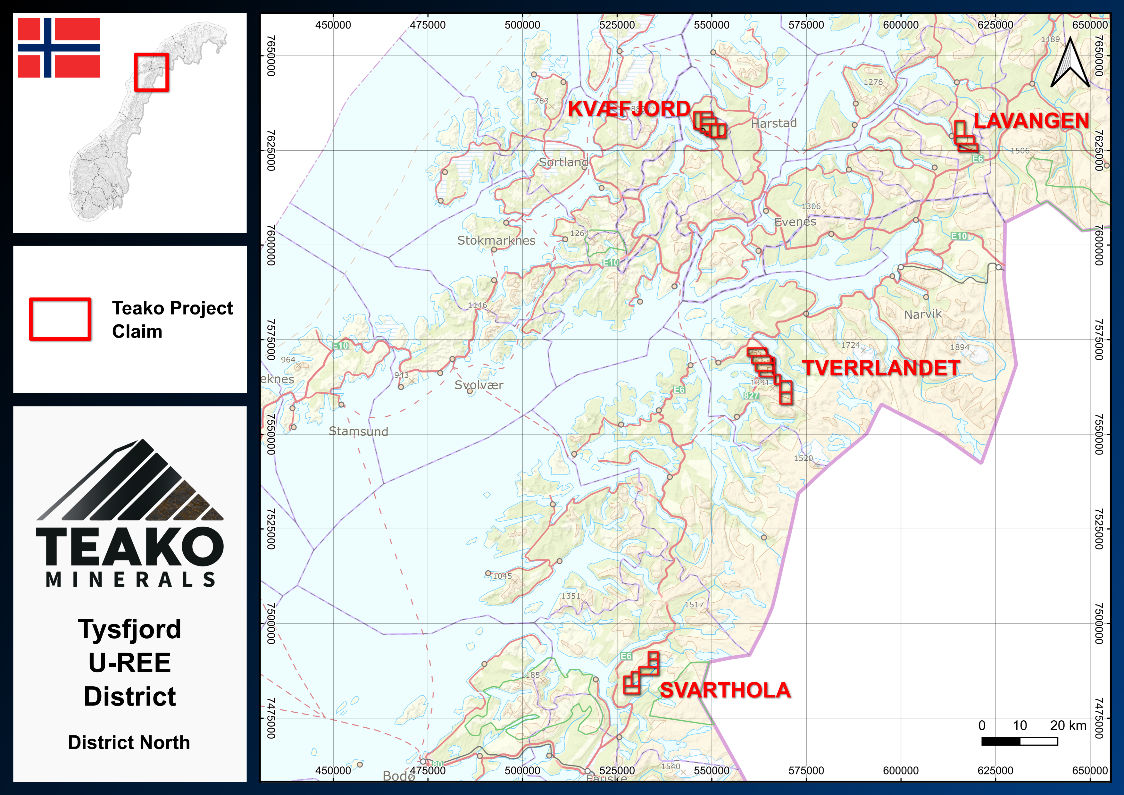
VANCOUVER, B.C. | November 27, 2025 | Teako Minerals Corp. (CSE: TMIN) (the “Company” or “Teako”) is pleased to announce the successful completion of its 2025 field program on four (4) 100%-owned uranium (“U”) projects in northern Norway (the “Projects”). The field mapping/sampling program has confirmed the prospectivity of these Projects for uranium deposits associated with felsic intrusions / pegmatites, and was complemented by a ground gamma-ray spectrometry survey which returned elevated U concentrations (up to 7,114 ppm1) at the Svarthola project. The northern Norway U Projects form part of the energy metals portfolio within the Company’s Project Hub model, and complement the Company’s ongoing exploration focus on its base metals projects in the County of Trøndelag.
2025 Uranium Field Program
Field work conducted at the Svarthola, Tverrlandet, Lavangen, and Kvæfjord Projects (or each a “Project”) in northern Norway (Figure 1) comprised detailed geological mapping and sampling of uranium mineralization across all four projects, complemented by ground-based gamma-ray spectrometry surveys conducted with a Georadis GT40 spectrometry unit (“GT40”) to acquire uranium concentrations.
1 Spectrometer analyses were performed on select samples which may not be representative of all mineralization hosted within the Projects.
The Svarthola Project
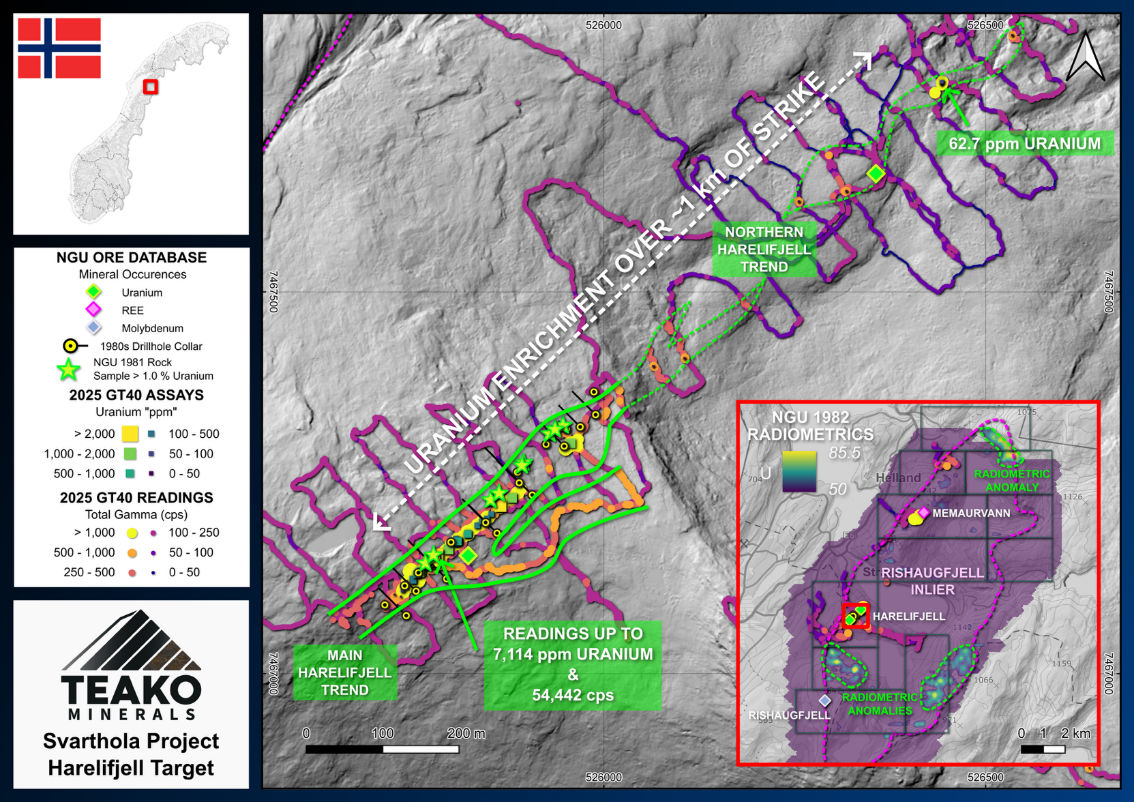
The Svarthola Project is situated approximately 10 km north of the town and port of Fauske in Nordland and contains the Harelifjell occurrence (“Harelifjell”). Mineralization at Harelifjell has been identified as zones of uraninite mineralization within an aplite body. This aplite can be traced up to 1.4 km NE-SW with historic rock-chip grades confirmed up to 5% U (Lindhal 1984)2. The target was to characterize the Harelifjell mineralization, sample the known mineralized areas and map out radiometric anomalies associated with the occurrence, via a high-resolution survey with the GT40.
Mineralization consists of fracture zones and dark black biotite-uraninite within the aplite body, with U grades from the Company´s survey reaching 7,114 ppm (Figure 2). Historical drilling failed to replicate surface grades and raised questions about depth continuity. However, to the northeast of Harelifjell the GT40 also identified areas with U enrichment at significantly lower topographical elevation, suggesting greater potential depth continuity of mineralization than previously thought at Harelifjell. This second area of enrichment highlights the strike potential of the Svarthola Project, with initial exploration confirming U potential over a minimum 1 km strike length.
The Tverrlandet Project
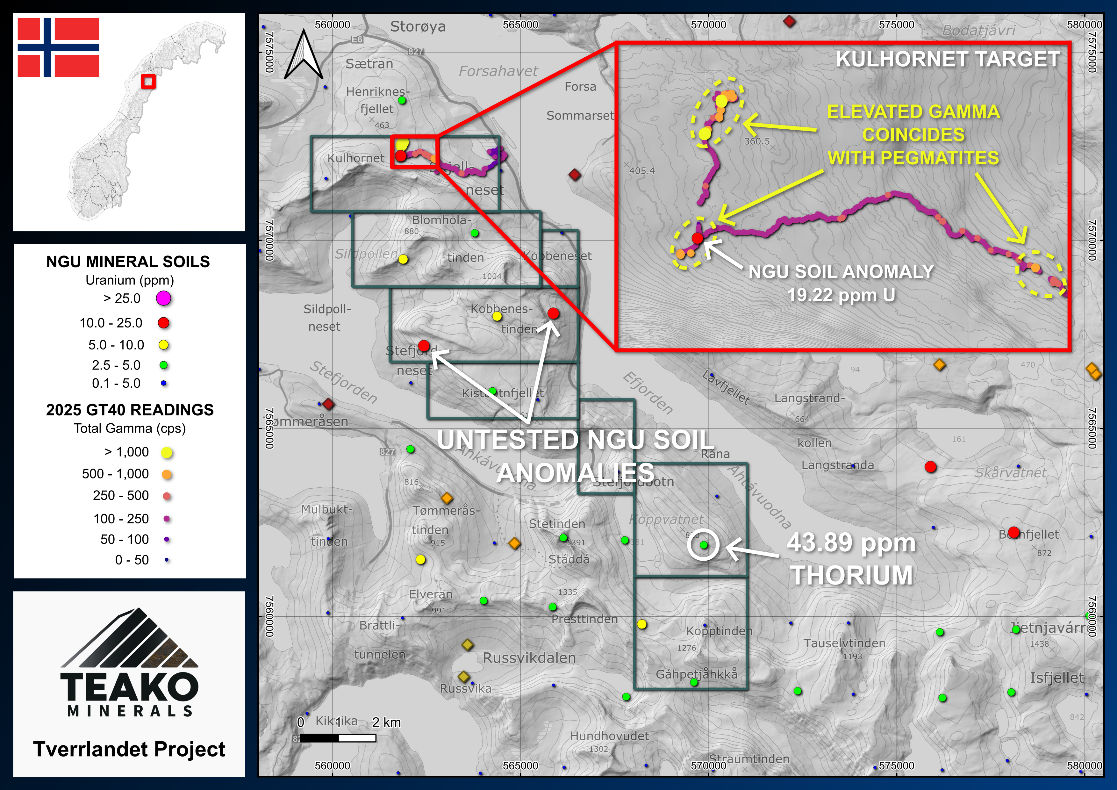
At the Tverrlandet Project, which is situated approximately 45 km southwest of Narvik, the focus was to assess the rare earth elements (“REE”) and U potential of the northern Tysfjord basement window, within the TIB-2 granites. Historical soil geochemistry data collected by the Norwegian Geological Survey (the ”NGU”) identified local soil anomalies reading up to 19.2 ppm U2, recorded around the area the Teako field crew focussed its exploration efforts. The results of the GT40 survey of the area showed U enrichment in and around pegmatites, with elevated gamma readings identified around the new Kulhornet target (Figure 3). The general locations and elevated values of the uranium in the soil data provided by the NGU raises questions regarding the source of these elevated values, if they are also linked to pegmatites, or if there is a second source of uranium in this region.
The Lavangen Project The Lavangen Project is situated 37 km north of the major port of Narvik and hosts the pegmatite hosted Spansdalen uranium occurrence, the focus base of this initial investigation. Radiometric studies of this area in the 1980’s highlighted the Spansdalen occurrence to contain values reaching 2543 ppm U (Lindhal 1983)2. Rock samples taken by the NGU in the 1990’s also revealed uranium grades up to 1155 ppm2. The goal was to assess the historical Spansdalen occurrence with the GT40 and extend this survey over select areas of interest. The GT40 results showed readings of mineralization (up to 930 ppm U1)(Figure 4).

Within the Spansdalen occurrence uranium and molybdenum mineralization was identified by field crews within fracture zones (Figure 5). This enrichment may suggest that the pegmatites at the Lavangen Project are part of a system of later phase or evolved pegmatitic intrusions with structures present across the project area. The orientation of this outcropping mineralization indicates the potential for strike extension to the northeast.

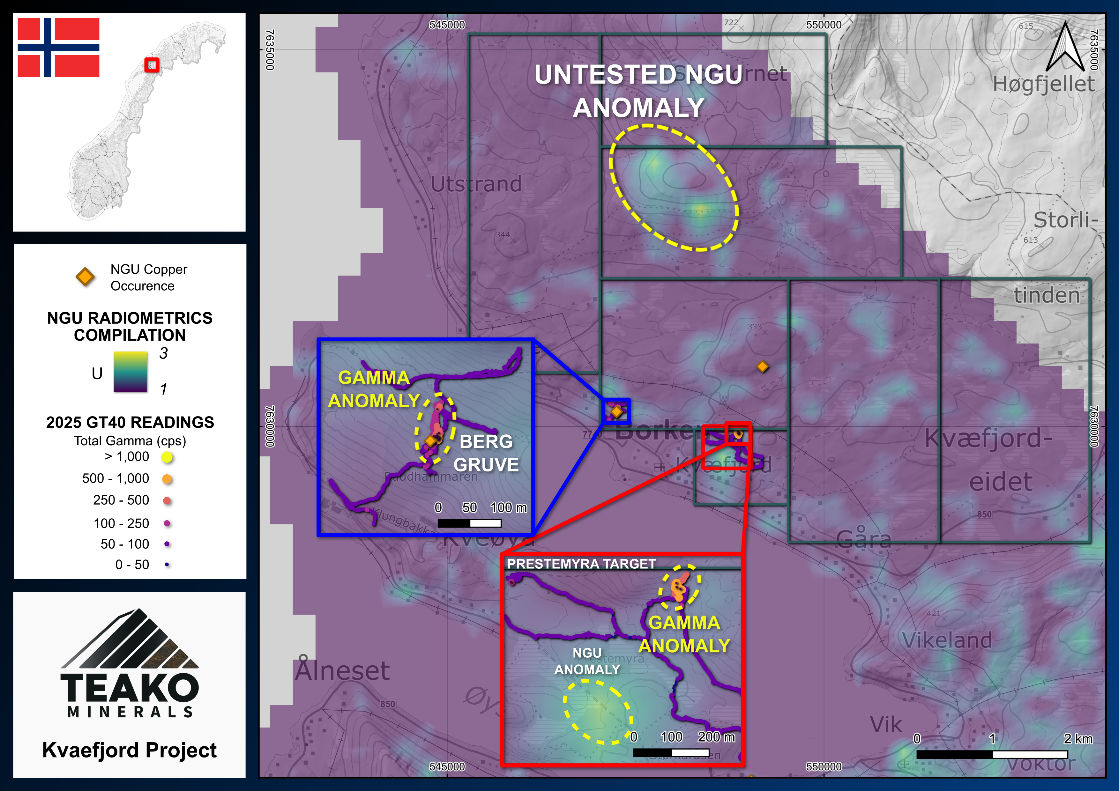
The Kvæfjord Project At the Kvæfjord Project, which lies approximately 10 km west of the town of Harstad, exploration efforts concentrated around the historical Berg disseminated sulphide deposit, with a renewed focus on its uranium potential. Historic work around the old workings was focussed on base metal extraction with chalcopyrite and pyrrhotite being the main sulphides present. Uraninite mineralization has been found around the Berg deposit itself with the NGU reporting mineralization up to 9181 ppm U and with work in 1982 reporting grades of 0.3% U (Often, 1982)2. The GT40 survey over the area identified uranium with assay function data (reaching 24 ppm1). These data were compared to regional and historical data which highlights untested areas with promising radiometric data, with the largest anomaly being in the northern part of the Project (Figure 6).
2 The Company has not undertaken sufficient analytical work to confirm reported historical assay results, but believes these to be reliable and relevant to the discussion on known mineralization at the Projects.
Qualified Persons and Disclosure Statement
The technical information presented in this news release has been prepared in accordance with Canadian regulatory requirements as set out in National Instrument 43-101 (“NI 43-101”) Standards of Disclosure for Mineral Projects, and reviewed and approved by Eric Roth, a Non-Executive Director of Teako and Qualified Person under NI 43- 101. Mr. Roth holds a Ph.D. in Economic Geology from the University of Western Australia, is a Fellow of the Australian Institute of Mining and Metallurgy (AusIMM), and is a Fellow of the Society of Economic Geologists. Mr. Roth has over 35 years of experience in international minerals exploration and mining project evaluation.
About Teako Minerals Corp.
Teako Minerals Corp. is a Vancouver-based mineral exploration company committed to acquiring, exploring, and developing mineral properties in Norway, focusing on critical metals such as copper, cobalt, zinc and molybdenum. By leveraging leading-edge exploration technologies and strategic partnerships, Teako aims to address the growing demand for essential minerals while generating value for shareholders and stakeholders alike.
Teako’s Project Hub, including the Løkken and Venna main projects, covers an extensive land package prospective for copper, cobalt, zinc, gold, platinum group elements (or “PGE”), uranium, antimony, molybdenum and rare-earth-elements.
The Project Hub strategy was initially developed from the Company’s first-mover advantage in-country, leveraging both technical skill and strong local community engagement to acquire and advance groups of both core and non-core assets. Core assets such as the Løkken-Venna district remain integral to the Company’s self-funded exploration programs, whereas the Company aims to retain exposure to exploration success on non-core assets through securing deals with strong partners. These deals, if secured, are intended to potentially bring in capital and/or ongoing cash flow, retain upside exposure, and reduce overall risk, thereby strengthening Teako’s foundation. Teako holds a 10% economic interest in the Hulderdalen, Moelva, Kvelde and Skåråfjell projects owned by Fritzøe Skoger AS.
Contact Information:
Sven Gollan – CEO T: +1 (604)-871-4301 Email: sven.gollan@teakominerals.com
Forward-Looking Information:
This press release may include forward-looking information within the meaning of Canadian securities legislation, concerning the business of Teako. Forward-looking information is based on certain key expectations and assumptions made by the management of Teako. In some cases, you can identify forward-looking statements by the use of words such as “will,” “may,” “would,” “expect,” “intend,” “plan,” “seek,” “anticipate,” “believe,” “estimate,” “predict,” “potential,” “continue,” “likely,” “could” and variations of these terms and similar expressions, or the negative of these terms or similar expressions. Forward-looking statements in this press release include statements related to (i) the Company’s expectations and views with respect to certain mining jurisdictions, future transactions and the Company’s plans. Although Teako believes that the expectations and assumptions on which such forward-looking information is based are reasonable, undue reliance should not be placed on the forward-looking information because Teako can give no assurance that they will prove to be correct. Since forward-looking statements address future events and conditions, by their very nature, they involve inherent risks and uncertainties. Actual results could differ materially from those currently anticipated due to a number of factors and risks. These include but are not limited to, risks associated with the mineral exploration industry in general (e.g., operational risks in development, exploration and production; the uncertainty of mineral resource estimates; the uncertainty of estimates and projections relating to production, costs and expenses, and health, safety and environmental risks), constraint in the availability of services, commodity price and exchange rate fluctuations, changes in legislation impacting the mining industry, adverse weather conditions and uncertainties resulting from potential delays or changes in plans with respect to exploration or development projects or capital expenditures. These and other risks are set out in more detail in Teako’s interim Management’s Discussion and Analysis, July 31, 2025. All dollar figures included herein are presented in Canadian dollars, unless otherwise noted. Neither the CSE nor its market regulator accepts responsibility for the adequacy or accuracy of this press release.
References Lindahl, I. (1983) Radiometriske bilmålinger i Troms 1983. NGU Rapport 84.062. Trondheim: Norges Geologiske Undersøkelse.
Often, M. (1982) Geologiske undersøkelser og diamantboring ved Berg Gruve, Borkenes. NGU Rapport BV1151 Trondheim: Norges geologiske undersøkelse.
Finne, T.-E. & Eggen, O. A. (2013) Soil geochemical data from Nord-Salten, Nordland. NGU Rapport 2013.015. Trondheim: Geological Survey of Norway (for data used in figures)
Lindahl, I. (1984) Rishaugfjellvinduet og Harelifjell uranmineralisering. NGU Rapport 84.057. Trondheim: Norges geologiske undersøkelse 400-601 West Broadway, Vancouver, BC, V5Z 4C2 TEL +1 (604)-871-4301 www.teakominerals.com
VANCOUVER, B.C. | November 26, 2025 | Teako Minerals Corp. (CSE: TMIN) (the “Company” or “Teako”) is pleased to announce the successful completion of its 2025 field program at the Løkken and Venna projects in central Norway, which included: (i) detailed mapping and sampling at the 90%-owned portion of the Løkken copper-cobalt-zinc (“Cu-Co-Zn”) project (the “Løkken Project”), supported by a structural assessment of drill core and the digitization of historical data; (ii) mapping and sampling at the 100% owned Venna Cu-Co-Zn project (the “Venna Project”), which has led to the development of a significant new massive sulfide (“VMS”) target in the Mostadmarka Ironworks area.
Highlights
- Teako has identified a significant new VMS target (the “Mostadmarka Target”) in the Mostadmarka Ironworks area at its Venna Project. The area contains extensive formations of jaspers and quartz-magnetite cherts (>20km cumulative strike length) interpreted to be distal indicators of Cu-rich massive sulfide deposits.
- Assay results for 61 grab / rock chip samples taken from the Mostadmarka Target are currently pending.
- At the Løkken Cu-Co-Zn VMS Project, field crews completed comprehensive sampling and mapping programs on the Høydal, Dragset, and Grefstofjellet targets.
- Full structural assessment of drill core from holes AM-25-001 and HOY-25-001 (completed during Teako’s maiden 2025 drill program at the Åmot and Høydal targets) was conducted as part of an MSc research project in collaboration with Cardiff University. This work, which included detailed structural mapping of the Høydal and Åmot target areas aims to improve understanding of local structural controls and support refined drill targeting.
In addition, substantial desk-based research, data compilation, digitization and technical reporting has been completed across Teako’s project portfolio to strengthen geological understanding and support business objectives. Teako also announces that the contemplated drill program with its technology-partner company at the Løkken Fjelslett target has been postponed due to partner-related delays.
The Venna Project Field Program
The Teako field team has successfully completed a sampling and mapping program at the Venna Project over the newly identified Mostadmarka Target for which laboratory results are pending. Additionally, mapping around the Sandsve copper occurence and surface assessment of two regional electromagnetic targets was conducted (Figure 1, Anomaly 1, Anomaly 2).
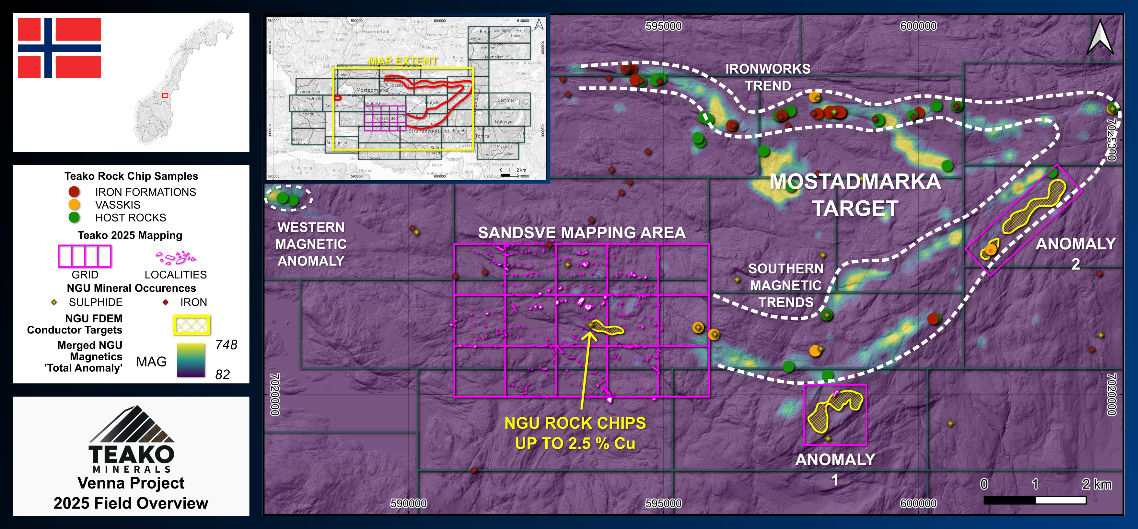
The Venna Project lies within the Norwegian Caledonides, formed during the Caledonian Orogeny, and is interpreted to extend from the productive VMS districts in northeastern Canada (Bathurst Mining Camp, New Brunswick; Buchans District, Newfoundland) and the Appalachian US to Norway. The Venna Project situates 30km SE of the regional administrative centre of Trondheim, in the County Trøndelag, central Norway and has been underexplored compared to surrounding areas such as those around the historical Løkken mine to the west. Historic small-scale iron mining has been the sole focus, with limited systematic exploration undertaken to understand the potential for buried Cu-Zn deposits.
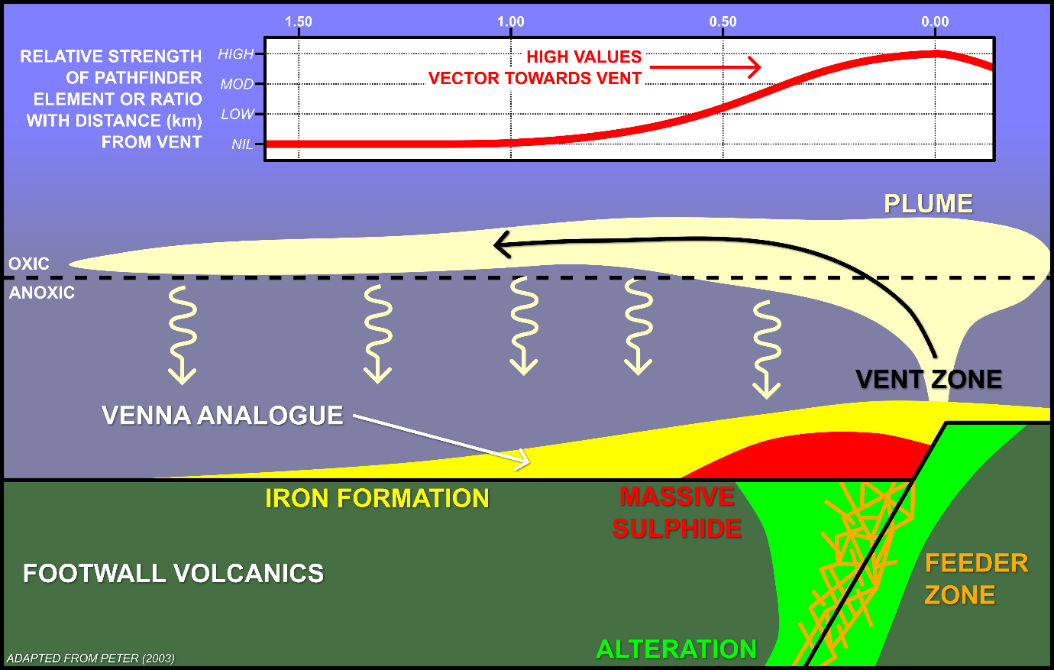
Iron formations are a key feature of the Løkken district and other global volcanogenic massive sulfide (“VMS”) districts including the Bathurst Mining Camp in Canada. These iron formations can form through the exhalation or replacive-action of hydrothermal fluids at or below the paleo-seafloor, indicating them as potentially prospective marker horizons for VMS- style Cu-Zn mineralization. The Venna Project hosts the historical Mostadmarka Ironworks area (the “Ironworks Trend”) (see Figure 1), a series of (over 200) small historical near-surface workings that targeted laterally extensive jaspers and quartz-magnetite cherts. Parallels can be drawn to the Bathurst Mining Camp, which first saw mining activity targeting similarly hematite- and magnetite-rich iron formations at the Austin Brook deposit.
After samples revealed base metal mineralization in the footwall of the Austin Brook deposit1, exploration along strike resulted in the discovery of the Brunswick No. 6 deposit (12.125 Mt produced @ 5.43% Zn, 2.16% Pb, 0.39% Cu, 67.0 g/t Ag (Luff et al., 1993)) and later the Brunswick No. 12 deposit (137 Mt produced @ 8.74% Zn, 3.44% Pb, 0.37% Cu, 102 g/t Ag). In the early 2000s, research into the geochemistry of the iron formations in the Bathurst Mining Camp was published, revealing a range of pathfinder elements and indices that were demonstrated to vector towards the major known deposits in the region (Peter, 2003). These prospectivity indicators have since been investigated in other districts within the Appalachian-Caledonian belt, including a study completed in the Tyrone Igneous Complex in Ireland (Hollis et al., 2015). At Teako’s nearby Løkken Project, a study into the geochemistry of jasper horizons has also proven effective in identifying geochemical signals that vector towards the Høydal deposit (Grenne and Slack, 2005).
Elsewhere in the Støren Nappe, which is part of the Trondheim Nappe Complex, the Tverfjellet deposit (15 Mt produced at 1.0 % Cu and 1.2 % Zn1) at Hjerkinn, Norway, showed close associations between Cu-rich ore and quartz-magnetite iron formations, further suggesting that large base metal systems in the region can produce extensive iron formations over VMS systems. The geochemical sampling program at the Mostadmarka Target aims to emulate these studies.
References made to other mines/projects provide context for Teako’s projects but are not necessarily indicative that the projects host similar tonnages or grades of base- and/or precious metals mineralization.
In a typical VMS model, iron formations can be deposited on the same horizon as massive Cu-Zn sulfide mineralization, and the Company believes the same geological model (Figure 2) could apply to the Venna project. The premise is that geochemical assays of iron-formation material can be used to vector toward the vent zones of buried VMS systems.
At the Venna Project’s Mostadmarka Target, a total of 45 rock-chip samples have been collected along 10 km of the northern Ironworks Trend. In addition, 14 rock-chip samples have been collected from a series of anomalies along 8.6 km of the 10 km southern magnetic trend (>20km cumulative strike length across the northern and southern trend), and 2 rock-chip samples were taken from the western magnetic anomaly (Figure 1).
All samples were prepped for laboratory analysis, and a total of 61 samples were dispatched to a certified laboratory in late October, with assay results expected within 4-6 weeks of the laboratory receiving the samples. The results are expected to provide initial insights into two key features of this prospective terrane: the exhalative iron formations (e.g. cherts, jaspers, ‘Vasskis’) and the host volcanic stratigraphy.
The analysis will screen for indications that these iron formations formed from high temperature, VMS-fertile fluids. Promising signals will be used as vectors to guide future exploration activities towards the most prospective zones of the sampled areas. In addition, understanding the geochemistry of the host rocks around these minor historical mines will help to fingerprint the prospective stratigraphic package, as well as screening for zones of hydrothermal alteration that may mark crucial VMS feeder zones, like those seen in the footwall of many VMS deposits including the historical Løkken, Høydal and Dragset deposits.
At one of the two regional electromagnetic targets (Anomaly 2, Figure 1) previously undocumented pyrite mineralization was discovered. Although the full extent of this mineralization is not yet known, the discovery confirms the presence of hydrothermal activity in the area and delineates a priority zone for follow-up assessment.
Mapping and sampling was successfully completed around the historical Sandsve occurence, and has proven valuable in the assessment of the area. The Company has undertaken ’in house’ pXRF analysis on samples from this area, results of which will compliment results at the Mostadmarka Target.
The Løkken Project Field Program
The Løkken Project is located approximately 50km SW of the regional administrative centre of Trondheim, Trøndelag Province, central Norway and covers the former Løkken mining district (reported historical production of 24MT @ 2.3% Cu + 1.9% Zn plus silver and gold credits2). The former Løkken mine is considered to be one of the largest ophiolite-hosted Cyprus-type VMS deposits (by tonnage) to have been developed in the world.
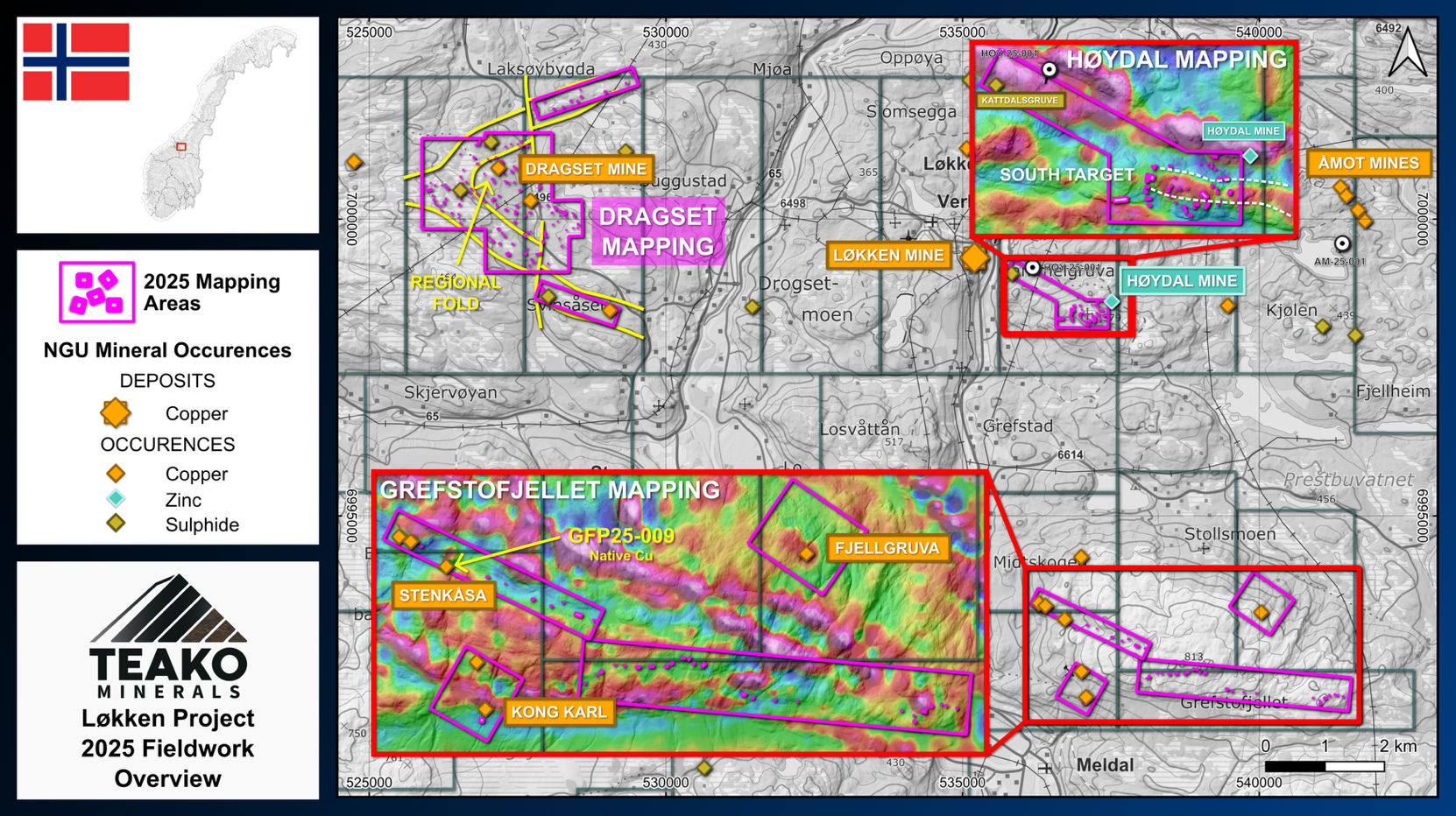
Teako’s field crews have successfully completed a comprehensive sampling and mapping program focused on the Høydal (the ”Høydal Target”), Dragset (the ”Dragset Target”), and Grefstofjellet (the ”Grefstofjellet Target”) targets within the Company’s 90%-owned portion of the Løkken Project (see Figure 3).
In addition, full structural assessment has been completed for drill core from holes AM-25-001 and HOY-25-001, which were drilled during Teako’s maiden 2025 program at the Åmot and Høydal targets. This assessment was carried out as part of an MSc research project in collaboration with Cardiff University and included detailed structural mapping of the Høydal and Åmot target areas. The objective of this work is to improve understanding of local structural controls and to support refined drill targeting. Final results from the structural assessment are pending.
Historic production values quoted for Løkken are from Grenne T, Ihlen PM, Vokes FM (1999) Scandinavian Caledonide metallogeny in a plate- tectonic perspective. Mineral Deposita 34:422–471. Teako has not performed sufficient work to verify the published data reported above, but the Company believes this information to be considered reliable and relevant.
The Høydal Target
At the Høydal Target, mapping and sampling efforts concentrated on a target located south of, and parallel to, the main historical Høydal zinc trend, which is defined by both electromagnetic (EM) and magnetic anomalies. Geological marker horizons identified in the area indicate favourable stratigraphy along the trend. However, the source of the EM anomaly could not be resolved at surface, highlighting the need for drill testing. Rock-chip samples have been collected throughout the area and will undergo internal analysis with the resulting interpretations to assist in evaluating phase 2 drill targeting options.
The Dragset Target
At the Dragset Target, mapping of both limbs of the known Løkken synform and detailed mapping across the various volcanic members was undertaken. This was the first significant field assessment of the potential for VMS-style mineralization west of the Løkken mine (see press release dated December 4, 2024). Multiple volcanic members have been categorised and geochemistry data from samples taken will be used in conjunction with available historic data to review targets in this area.
The Grefstofjellet Target
At the Grefstofjellet target all surface signatures of any VTEM anomalies were mapped and select rock-chip samples from surface expressions of mineralization were taken, with one surface sample (sample ID: GFP25-009) (Figure 3) containing minor native copper. Assessment of the geochemistry data collected, alongside the regional data will be conducted over the winter.
Next Steps
Next steps at the Venna Project include the review of pending sample assays from the Mostadmarka Target collected during the 2025 field season, together with the integration of internal results from the Company’s 2025 and 2024 field programs, regional geophysical datasets, and other available historical information. The Company may also evaluate additional high- resolution surveys as part of its ongoing efforts to refine and advance potential drill targets at Venna.
The next steps at the 90%-owned portion of the Løkken Project will involve a comprehensive review and assessment of data collected in 2025, including the pending results of the structural assessment, alongside prior datasets, to support the evaluation of phase 2 drill targeting opportunities.
Qualified Persons and Disclosure Statement
The technical information presented in this news release has been prepared in accordance with Canadian regulatory requirements as set out in National Instrument 43-101 (“NI 43-101”) Standards of Disclosure for Mineral Projects, and reviewed and approved by Eric Roth, a Non-Executive Director of Teako and Qualified Person under NI 43- 101. Mr. Roth holds a Ph.D. in Economic Geology from the University of Western Australia, is a Fellow of the Australian Institute of Mining and Metallurgy (AusIMM), and is a Fellow of the Society of Economic Geologists. Mr. Roth has over 35 years of experience in international minerals exploration and mining project evaluation.
About Teako Minerals Corp.:
Teako Minerals Corp. is a Vancouver-based mineral exploration company committed to acquiring, exploring, and developing mineral properties in Norway, focusing on critical metals such as copper, cobalt, zinc and molybdenum. By leveraging leading-edge exploration technologies and strategic partnerships, Teako aims to address the growing demand for essential minerals while generating value for shareholders and stakeholders alike.
Teako’s Project Hub, including the Løkken and Venna main projects, covers an extensive land package prospective for copper, cobalt, zinc, gold, platinum group elements (or “PGE”), uranium, antimony, molybdenum and rare-earth-elements.
The Project Hub strategy was initially developed from the Company’s first-mover advantage in-country, leveraging both technical skill and strong local community engagement to acquire and advance groups of both core and non-core assets. Core assets such as the Løkken-Venna district remain integral to the Company’s self-funded exploration programs, whereas the Company aims to retain exposure to exploration success on non-core assets through securing deals with strong partners. These deals, if secured, are intended to potentially bring in capital and/or ongoing cash flow, retain upside exposure, and reduce overall risk, thereby strengthening Teako’s foundation. Teako holds a 10% economic interest in the Hulderdalen, Moelva, Kvelde and Skåråfjell projects owned by Fritzøe Skoger AS.
Contact Information:
Sven Gollan – CEO T: +1 (604)-871-4301 Email: sven.gollan@teakominerals.com
Forward-Looking Information:
This press release may include forward-looking information within the meaning of Canadian securities legislation, concerning the business of Teako. Forward-looking information is based on certain key expectations and assumptions made by the management of Teako. In some cases, you can identify forward-looking statements by the use of words such as “will,” “may,” “would,” “expect,” “intend,” “plan,” “seek,” “anticipate,” “believe,” “estimate,” “predict,” “potential,” “continue,” “likely,” “could” and variations of these terms and similar expressions, or the negative of these terms or similar expressions. Forward-looking statements in this press release include statements related to (i) the Company’s expectations and views with respect to certain mining jurisdictions, future transactions and the Company’s plans. Although Teako believes that the expectations and assumptions on which such forward-looking information is based are reasonable, undue reliance should not be placed on the forward-looking information because Teako can give no assurance that they will prove to be correct. Since forward-looking statements address future events and conditions, by their very nature, they involve inherent risks and uncertainties. Actual results could differ materially from those currently anticipated due to a number of factors and risks. These include but are not limited to, risks associated with the mineral exploration industry in general (e.g., operational risks in development, exploration and production; the uncertainty of mineral resource estimates; the uncertainty of estimates and projections relating to production, costs and expenses, and health, safety and environmental risks), constraint in the availability of services, commodity price and exchange rate fluctuations, changes in legislation impacting the mining industry, adverse weather conditions and uncertainties resulting from potential delays or changes in plans with respect to exploration or development projects or capital expenditures. These and other risks are set out in more detail in Teako’s interim Management’s Discussion and Analysis, July 31, 2025. All dollar figures included herein are presented in Canadian dollars, unless otherwise noted. Neither the CSE nor its market regulator accepts responsibility for the adequacy or accuracy of this press release.
Quellen
Grenne, T. and Slack, J.F. (2005) ‘Geochemistry of Jasper Beds from the Ordovician Løkken Ophiolite, Norway: Origin of Proximal and Distal Siliceous Exhalites’, Economic Geology, 100, pp. 1511–1527.
Hollis, S.P. et al. (2015) ‘Distribution, mineralogy and geochemistry of silica-iron exhalites and related rocks from the Tyrone Igneous Complex: Implications for VMS mineralization in Northern Ireland’, Journal of Geochemical Exploration, 159, pp. 148–168. Available at: https://doi.org/10.1016/j.gexplo.2015.09.001.
Luff, W.M., Lentz, D.R. and van Staal, C.R. (1993) ‘The Brunswick No. 12 and No. 6 mines, Brunswick Mining and Smelting Corporation Limited’, in Guidebook to the Metallogeny of the Bathurst camp CIM, pp. 75–96.
Peter, J. (2003) ‘Ancient iron formations: their genesis and use in the exploration for stratiform base metal sulphide deposits, with examples from the Bathurst Mining Camp’, in Geochemistry of Sediments and Sedimentary Rocks: Evolutionary Considerations to Mineral Deposit-Forming Environments. Geological Association of Canada (Geotext, 4), pp. 145–176.
400-601 West Broadway, Vancouver, BC, V5Z 4C2 TEL +1 (604)-871-4301 www.teakominerals.com
Expanded Uranium Portfolio VANCOUVER, B.C. | July 22, 2025 | Teako Minerals Corp. (CSE: TMIN) (the “Company” or “Teako”) is pleased to announce the commencement of its summer 2025 field mapping and sampling program at its main Løkken and Venna copper-cobalt-zinc (“Cu-Co-Zn”) massive sulfide (“VMS”) projects, located in central Norway (the “Projects”). In addition, the Company is pleased to provide an update on its strategic Project Hub (the “Project Hub”), which includes the recent acquisition of nine uranium projects, nineteen VMS and base metal projects, and two rare earth element (or “REE”) projects (the “Properties”) from private Norwegian company Element29 AS (the “Vendor” or “Element29”)(the “Acquisition”). The Company’s immediate priorities are to continue advancing existing copper targets within the Løkken project area, together with the identification and prioritization of new additional drill targets within the broader Løkken – Venna property package. Prior to the commencement of the summer 2025 program, the Company deployed its in-house geological team to initiate a mapping and gamma-ray spectrometry program across its existing and newly acquired uranium projects primarily to confirm historical data acquired by previous operators. This program was driven by the increasing market interest in Norwegian uranium assets. Highlights:
- Teako has initiated its summer 2025 field program at the high-grade Cu-Co-Zn Løkken and Venna projects in central Norway. The field program at Løkken will focus on potential mineralized extensions to the former mining operations at Dragset, whilst field work at Venna will focus on defining the economic potential of areas of highgrade Cu mineralization. • Provides update on its strategic Project Hub portfolio and announces expansion through the acquisition of 9 uranium projects, 19 VMS and base metal projects, and 2 REE projects from private Norwegian company Element29. • Successfully completes mapping and gamma-ray spectrometry program across its existing and newly acquired uranium projects primarily to confirm historical data acquired by previous operators. • Teako’s Project Hub, including the Løkken and Venna main Projects, now consists of 58 projects covering a total area of 4,092 sq. km and prospective for copper, cobalt, zinc, gold, platinum group elements, uranium, antimony, molybdenum and rare-earth-elements and 4 projects wherein Teako holds a 10% economic interest. Løkken & Venna 2025 Summer Field Program: Teako’s 2025 summer field program will focus on advancing both its Løkken project, specifically around the Dragset- Halsetasen target, and the Venna project. Mapping and sampling at Dragset-Halsetasen will focus on the discovery of potential extensions to the known high-grade Cu mineralization at the former Dragset mining operations. The Venna program will focus on evaluating the economic potential of areas surrounding high-grade Cu-bearing outcrops discovered by previous operators, subsequently sampled by the Norwegian Geological Survey (or “NGU”) and most recently confirmed by Teako geologists during July 2025 reconnaissance exploration activities conducted as part of final planning for the 2025 summer field program.
Venna Program: The Venna project was a key focus of the Company’s 2024 summer field program (see Company New release dated November 19, 2024). The Company’s primary objective in the Venna project is to identify and delineate high-grade Løkkenstyle VMS deposits hosted within favourable stratigraphy along strike from the former Løkken mining operations. Teako’s field teams have recently confirmed high-grade outcropping Cu mineralization from the historic “SANDSVE” occurrence within the central portion of the Company’s Venna claims. This was confirmed through reconnaissance exploration activities using Teako’s Portable X-ray Fluorescence (or “pXRF”). On-site pXRF analyses of one grab sample in the area of interest returned values averaging 2.8% Cu (sample VNP25-001B)1. This high-grade sample adds to previous data obtained by the NGU in the same area whereby certified lab analysis of two grab samples in the area (SANDSVE-2, SANDSVE-3) returned elevated values of 2.5% Cu and 1.1% Cu respectively (see Figure 1).2 1,2 The reported sample constitutes a grab sample, which by definition is selectively obtained and may not be representative of all the mineralization within the property. Samples will be collected from sampling grids (see Figure 1) within the areas of identified elevated copper grades to confirm mineralization style and grade. Subsequently, detailed geological and structural mapping will be conducted, focusing on the central portion of the Venna project area. This program aims to identify additional, previously undocumented mineralization and to comprehensively characterize the area’s geology and structural controls on mineralization. VNP25-001B will be sent for laboratory analysis together with any samples of interest to be collected in this 2025 summer field program.

The geology of the Venna project is characterized by the Trondheim Nappe Complex comprising three greenschist-facies, basaltic metavolcanic belts: the Løkken-Vassfjellet-Bymarka (LVB) ophiolite to the northwest, the central belt including the Mostadmarka Formation, and the eastern Fundsjø Group. The Venna project specifically lies within the Mostadmarka Formation. These greenstone belts are separated from each other by metasedimentary units and structural features such as faults and disconformities. Løkken Program: The summer 2025 field program will focus on the Dragset-Halsetasen target, which hosts the former Dragset mining operations and is located approximately 5 km West of the former Løkken mine. The primary objective of this program is to identify potential extensions of the known Cu-Co-Zn mineralization. The field program at Dragset-Halsetasen is based on a comprehensive review of all available geological and exploration data, and will consist of systematic prospecting over known historic mine workings and detailed geological mapping of the broader prospective area within sampling grids where rock-chip samples will be regularly collected to support geochemical analysis. All samples will be logged for lithology and mineralization, with structural data recorded in detail. The area of primary focus for the 2025 summer field program is outlined by the yellow polygon (see Figure 2).
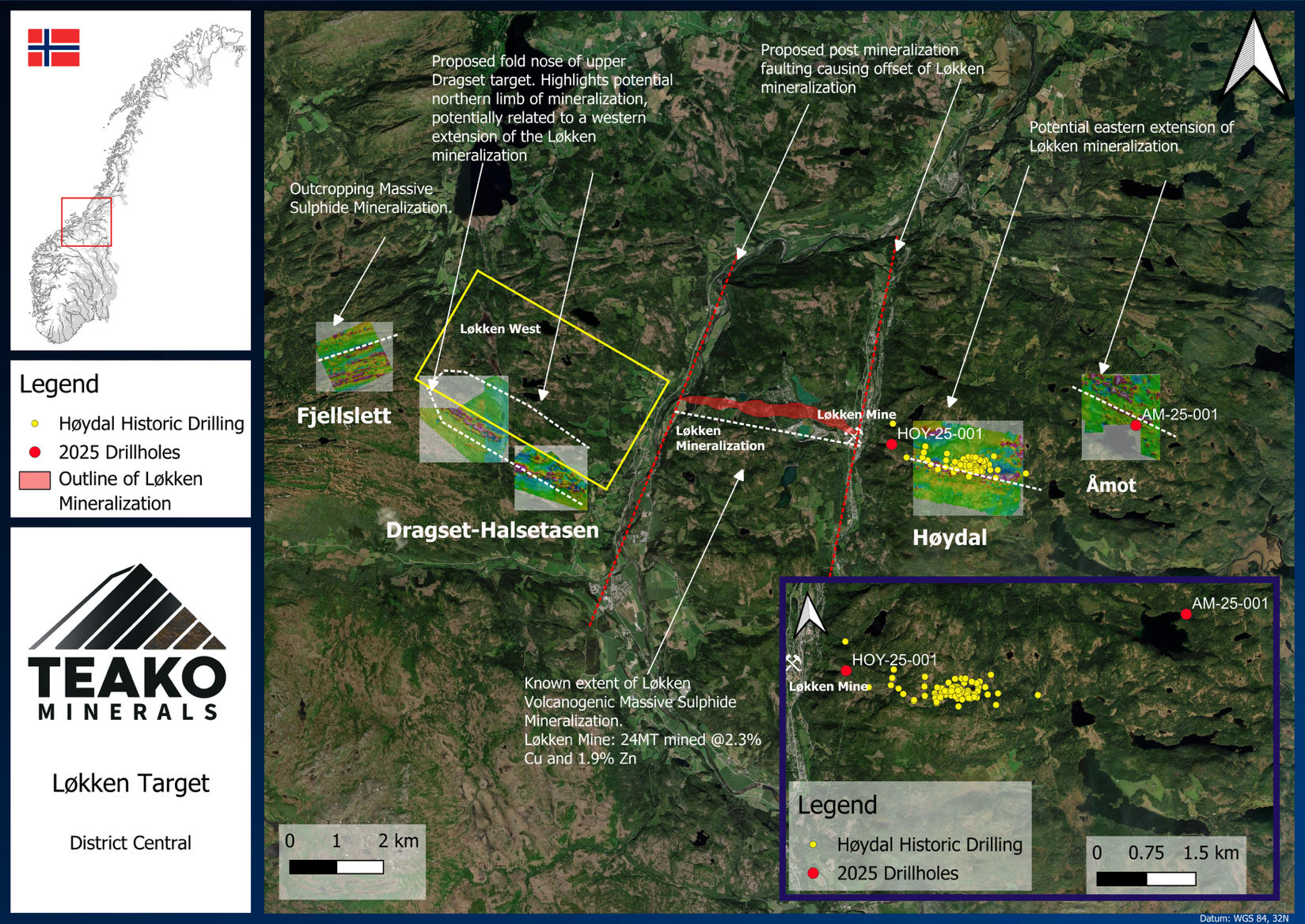
The Dragset target hosts a greenstone-hosted, pyrite-bearing massive sulphide deposit. The Cu-Co-Zn mineralization at Dragset is interpreted from both geological and geophysical data to be hosted within a fold nose, with the southern mineralized limb of the fold zone interpreted to extend eastwards towards the Halsetasen sector (see Figure 2). The Dragset deposit was first discovered in the late 1600’s and operated with interruptions until 1909 with a reported total production of approximately 65,000t @ 3.5% Cu3.
3 Metal production figures reported for Dragset are sourced from the Norwegian Geological Survey (“NGU”) online database at https://geo.ngu.no/kart/mineralressurser_mobil/?lang=nor. The Company has not completed sufficient work to verify the reported data, but believes the data to be accurate and relevant. Terms of the Element29 Transaction (the “Acquisition”) Pursuant to the Acquisition, Teako acquired a total of 30 Properties (9 uranium, 19 VMS and base metals, and 2 REE) from Element29 for a cash consideration of approximately NOK 226,740 (approximately C$30,000) which represents the Vendor’s costs of staking the projects. The Company has completed internal due diligence on the Element29 projects and is satisfied that all the mineral claims are in good standing. The Vendor is a holding company controlled by Mr. Sven Gollan, the Company’s Chief Executive Officer and a Director of the Company. As a result, the Acquisition constitutes a “related party transaction”, as such term is defined in Multilateral Instrument 61-101 – Protection of Minority Securityholders in Special Transactions (“MI 61-101”). In completing the Acquisition, the Company has relied on exemptions from the formal valuation and minority shareholder approval requirements enumerated in sections 5.5(a) and 5.7(1)(a) of MI 61-101, respectively, as neither the fair market value of the subject matter of the Acquisition, nor the consideration paid by the Company, exceeds 25% of the Company’s market capitalization. Updates to Project Hub The Project Hub strategy was initially developed from the Company’s first-mover advantage in-country, leveraging both technical skill and strong local community engagement to acquire and advance groups of both core and non-core assets. Core assets such as the Løkken-Venna district remain integral to the Company’s self-funded exploration programs going forward, whereas the Company aims to retain exposure to exploration success on non-core assets through securing deals with strong partners. These deals, if secured, are intended to potentially bring in capital and/or ongoing cash flow, retain upside exposure, and reduce overall risk, thereby strengthening Teako’s foundation. Upon completion of the Acquisition, Teako’s Project Hub, including the Løkken and Venna main projects, now consists of 58 projects covering a total area of 4,092 sq. km (or 409,200 hectares) and prospective for copper, cobalt, zinc, gold, platinum group elements (or “PGE”), uranium, antimony, molybdenum and rare-earth-elements and 4 projects wherein Teako holds a 10% economic interest (see Figure 3). This optimization of the Project Hub represents a 50% reduction in size compared to last year. Additionally, in a move to prioritize the most prospective areas, the Company has dropped its Vaddas project and streamlined and optimized its Løkken and Venna projects by reducing certain 100% owned claims (see Figure 4). The Løkken and Venna Projects now measures 405 sq. km and 292 sq. km, respectively.
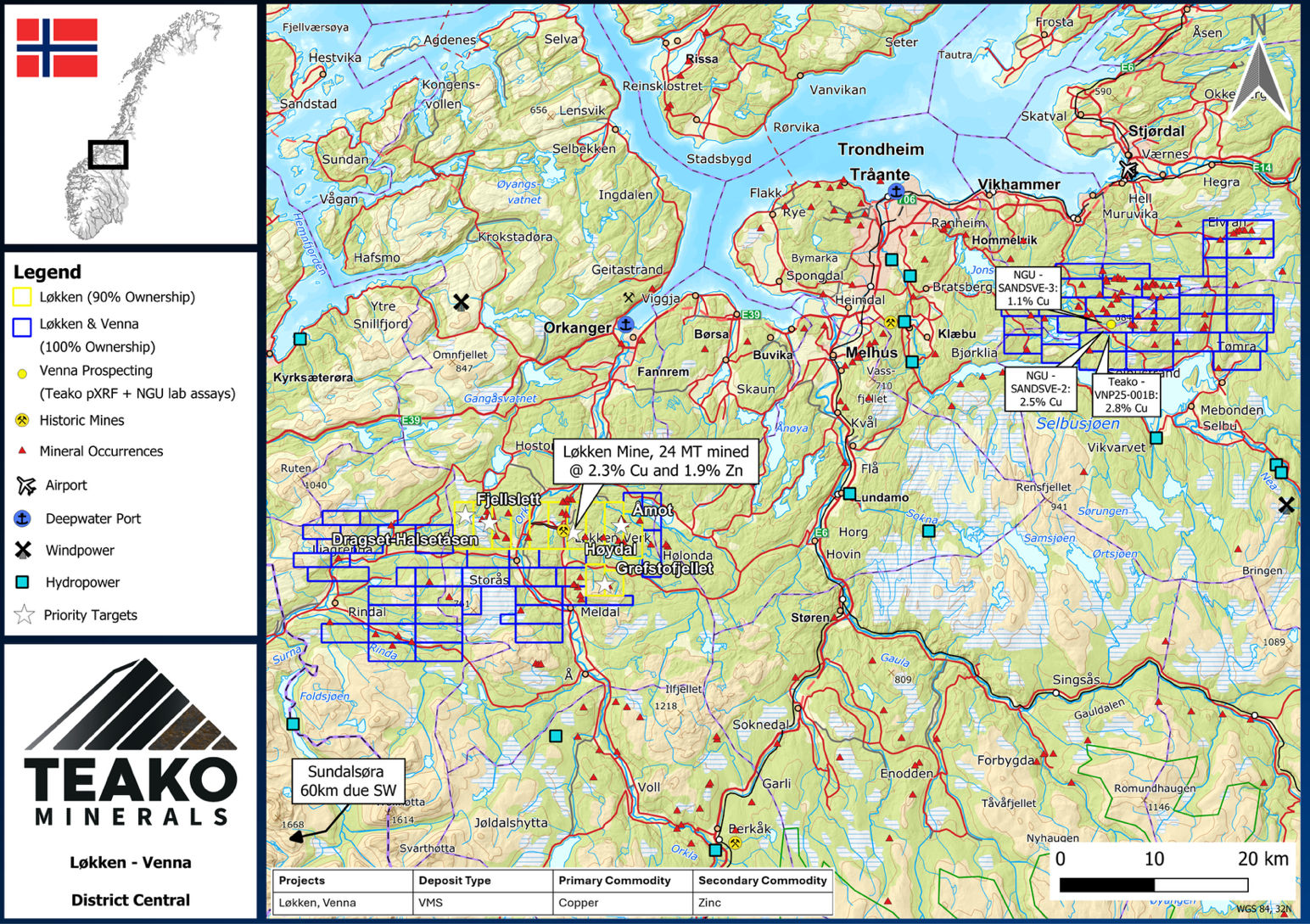
To view an enhanced version of Figure 3 please visit: http://teakominerals.com/wp-content/uploads/Teako-Minerals-Project-Hub-July-2025.png
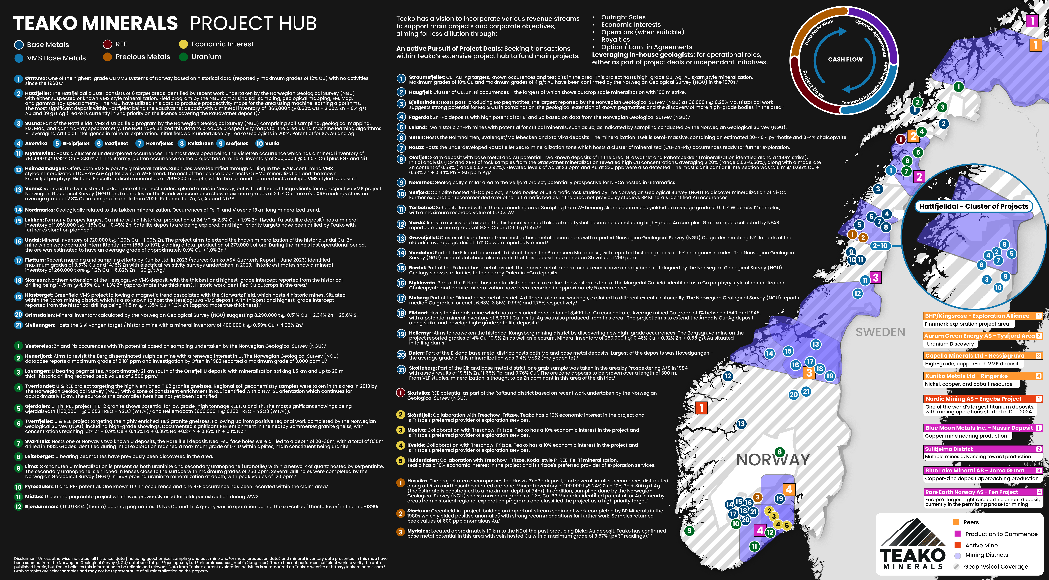
Qualified Person The technical information in this press release has been prepared in accordance with Canadian regulatory requirements as set out in National Instrument 43-101 (“NI 43-101”) Standards of Disclosure for Mineral Projects, and reviewed and approved by Eric Roth, a Non-Executive Director of Teako and Qualified Person under NI 43- 101. Mr. Roth holds a Ph.D. in Economic Geology from the University of Western Australia, is a Fellow of the Australian Institute of Mining and Metallurgy (AusIMM), and is a Fellow of the Society of Economic Geologists. Mr. Roth has over 35 years of experience in international minerals exploration and mining project evaluation. About Teako Minerals Corp.:
Teako Minerals Corp. is a Vancouver-based mineral exploration company committed to acquiring, exploring, and developing mineral properties in Norway, focusing on critical metals such as copper, cobalt, zinc and molybdenum. By leveraging leading-edge exploration technologies and strategic partnerships, Teako aims to address the growing demand for essential minerals while generating value for shareholders and stakeholders alike.
Contact Information:
Sven Gollan – CEO T: +1 (604)-871-4301 Email: sven.gollan@teakominerals.com
Forward-Looking Information:
This press release may include forward-looking information within the meaning of Canadian securities legislation, concerning the business of Teako. Forward-looking information is based on certain key expectations and assumptions made by the management of Teako. In some cases, you can identify forward-looking statements by the use of words such as “will,” “may,” “would,” “expect,” “intend,” “plan,” “seek,” “anticipate,” “believe,” “estimate,” “predict,” “potential,” “continue,” “likely,” “could” and variations of these terms and similar expressions, or the negative of these terms or similar expressions. Forward-looking statements in this press release include statements related to (i) the commencement, scope and objectives of the Company’s 2025 summer field mapping and sampling program and (ii) statements relating to the Company’s belief that market interest in Norwegian uranium assets is increasing, and that such interest influenced the initiation of the Company’s exploration activities and (iii) the Company’s expectations and views with respect to certain mining jurisdictions, future transactions and the Company’s plans. Although Teako believes that the expectations and assumptions on which such forward-looking information is based are reasonable, undue reliance should not be placed on the forwardlooking information because Teako can give no assurance that they will prove to be correct. Since forward-looking statements address future events and conditions, by their very nature, they involve inherent risks and uncertainties. Actual results could differ materially from those currently anticipated due to a number of factors and risks. These include but are not limited to, risks associated with the mineral exploration industry in general (e.g., operational risks in development, exploration and production; the uncertainty of mineral resource estimates; the uncertainty of estimates and projections relating to production, costs and expenses, and health, safety and environmental risks), constraint in the availability of services, commodity price and exchange rate fluctuations, changes in legislation impacting the mining industry, adverse weather conditions and uncertainties resulting from potential delays or changes in plans with respect to exploration or development projects or capital expenditures. These and other risks are set out in more detail in Teako’s interim Management’s Discussion and Analysis, for the period ended April 30, 2025.
All dollar figures included herein are presented in Canadian dollars, unless otherwise noted. Neither the CSE nor its market regulator accepts responsibility for the adequacy or accuracy of this press release.
400-601 West Broadway, Vancouver, BC, V5Z 4C2 TEL +1 (604)-871-4301 www.teakominerals.com
Additional Drill Permit for its Massive Sulfide Target at Fjellslett VANCOUVER, B.C. | May 22, 2025 | Teako Minerals Corp. (CSE: TMIN) (the “Company” or “Teako”) announces the completion of an inaugural diamond drill program at its Åmot and Høydal targets both part of its district-scale Løkken copper-cobalt-zinc (“Cu-Co-Zn”) volcanogenic massive sulfide (“VMS”) project in central Norway (the “Project”). The program comprised one hole at each target for a total of 364 meters (see Figure 1). Results include the intersection of 29.9 m of pyrite- and pyrrhotite-dominated vasskis horizons at Åmot, with the largest single horizon totaling a 20.4 m downhole intersect, interpreted by the Company as a sulphide-rich zone within the middle volcanic member of the prospective stratigraphy. At Høydal, drilling intersected a 4.9 m thick jasper-rich unit; jasper horizons typically occur in close proximity to VMS mineralization in the Løkken district. Downhole electromagnetic (or “DHEM”) surveys were completed for both holes. These surveys, used to detect nearby conductive (sulfide-bearing) bodies, have identified at least two targets requiring further investigation. Additionally, the Company is pleased to announce that it has secured drill permits for its Fjellslett VMS target, situated west of the former Løkken Mine (see Figure 1). The Fjellslett target is within the part of the Løkken Project, in which the Company acquired a 90% interest from Capella Minerals (TSXV: CMIL) in August 2024. This target hosts outcropping massive sulfide mineralization, and drilling is expected to commence in summer 2025. The drill program, will utilize The Coring Company’s sampling technology and is partly funded by Innovation Norway. Further details regarding this program will be issued prior to drilling commencement. Highlights
- Teako completed an inaugural diamond drill program on the Løkken property. The program was constrained by permitting requirements, necessitating completion by March 31 (Åmot) and April 11 (Høydal). • Åmot drill hole AM-25-001 (218.6 m) intersected 29.9 m of pyrite- and pyrrhotite-dominated vasskis horizons, with the largest single horizon being a 20.4 m downhole intersect (between 88.5 m and 108.9 m). • Høydal drill hole HOY-25-001 (145.6 m) intersected a 4.9 m thick jasper unit (from 68.2 m to 73.1 m), which typically occurs in close proximity to VMS mineralization in the Løkken district, plus narrow horizons of vasskis-style mineralization. • Samples from the sulfide bearing intervals at Åmot will be submitted to a certified laboratory for comprehensive analyses of Cu, Zn, gold (Au), and antimony (Sb) (results pending). • DHEM surveys completed for both drillholes identified a below-hole EM conductor at the Høydal target and a near edge hit at the Åmot target, with a larger EM signature nearby. • Phase II drilling is currently expected to be undertaken in late 2025. • Drill permit granted for the Fjellslett target with drilling expected to commence in summer 2025.
Sven Gollan, Chief Executive Officer, commented; “We are pleased to be announcing the initial observations from the first two diamond drill holes, completed at the Løkken project, both of which confirm the potential for discoveries of new massive sulfide deposits in previously undrilled areas. We look forward to building on the knowledge gained from this drilling and applying this towards an expected phase II drill program in late 2025”. Drill Program Overview Pyrite- and pyrrhotite-dominated mineralization was identified in both drill holes (see Table 1). Samples from the mineralized intervals at Åmot (for which initial pXRF analyses suggested elevated arsenic (As) values, and low contents of Cu and Zn) will be submitted to a certified laboratory for comprehensive analyses of Cu, Zn, gold (Au), and antimony (Sb) (results pending). Samples from Høydal will not be submitted for assay at this time. Interpretations of the downhole EM surveys, received by the Company on May 16, indicate a larger off-hole body of conductive material at Åmot and a belowhole conductor at Høydal. Table 1: Drill holes completed at the Løkken project
Hole
Easting (WGS84, 32N)
Northing (WGS84, 32N)
Elevation
Hole Diamter Azimuth Dip
Tiefe
(m) Åmot AM-25-001 541403 6999591 312 HQ + NQ 195 -45 218,6 Høydal HOY-25-001 536181 6999186 328 HQ + NQ 195 -50 145,6
Target
ID
(m)

The Åmot Target Åmot drill hole AM-25-001 was designed to partially test a large (up to 2 km in length) coincident EM, ground magnetic, and geochemical anomaly. AM-25-001 was successfully completed totaling 218.6 m, intersecting multiple pyrite- and pyrrhotite-dominated vasskis horizons (29.9 m total downhole thickness) with the largest single horizon totaling a 20.4 m downhole intersect from 88.5 m to 108.9 m. Upon literature comparison, the frequency and thickness of the vasskis horizons logged throughout the hole (see Picture 1) have indicated the stratigraphic location of this drill hole to be situated within a sulfide-rich zone within the middle volcanic member of favorable stratigraphy in the Løkken region. In VMS terrains, mineralization typically sits in a specific horizon within the geological stratigraphy and deposits often occur in clusters. This data provides geological understanding of the area, key for identifying potential Cu-Zn horizons. Future drilling can thereby be planned accordingly to better target the most prospective stratigraphic layers in the region.
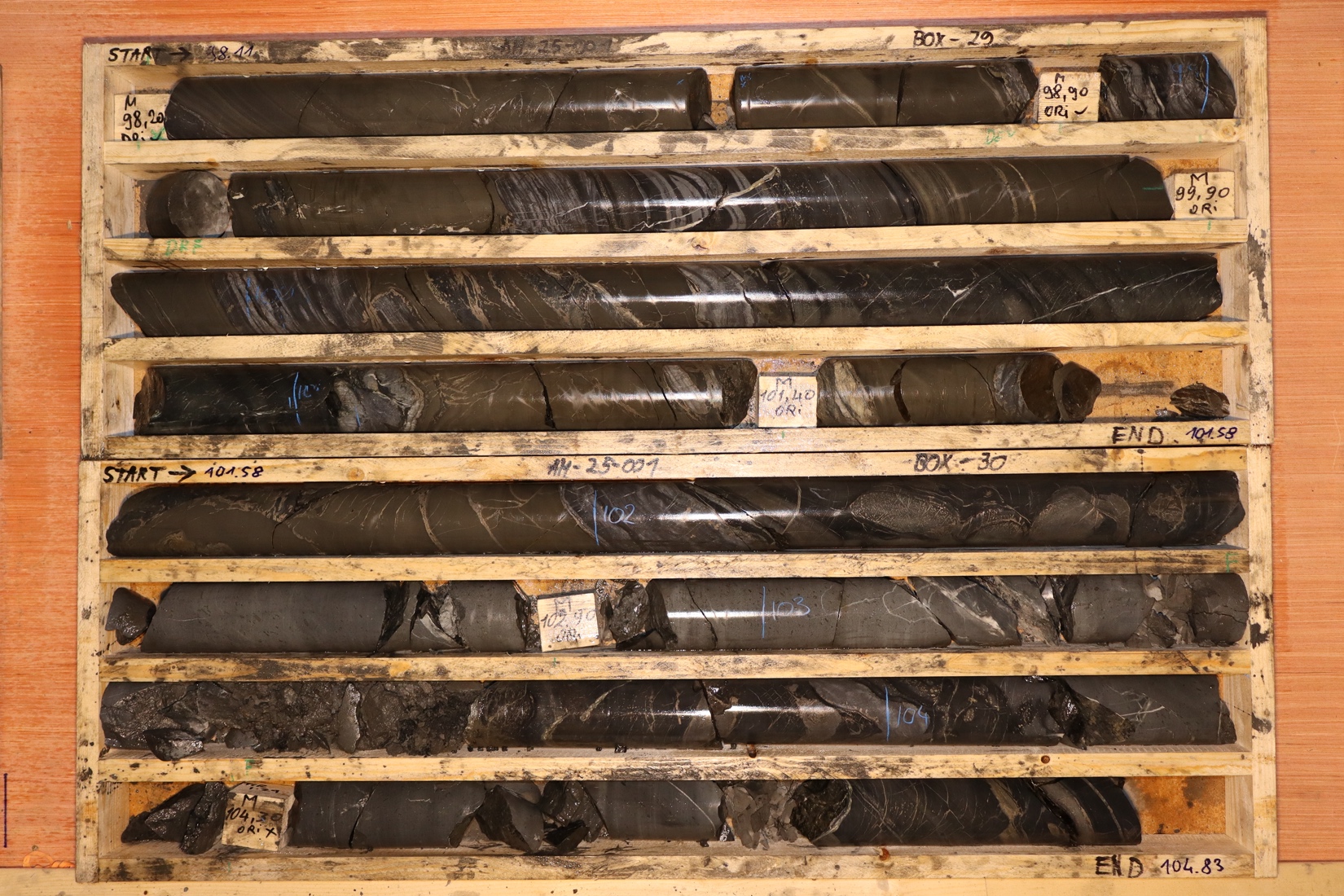
The geology above the main mineralized intersect features the general structures observed in the adjacent Løkken Mine (reported historical production of 24Mt at 2,3% Cu + 1,9% Zn)1, with remnant pillows, and alteration akin to that seen throughout the area. Contacts with the vasskis horizons are generally sharp, with some entrainment into the host lithology. From the interpretations of the DHEM survey undertaken at AM-25-001, it was confirmed that the EM signature correlates with the main vasskis unit from 88.5 m to 108.9 m. It was however noted that an off-hole anomaly was discovered at around 105.0 m, featuring a stronger signal than that identified in hole and is open at depth (see Figure 2). This was interpreted from the downhole survey as a ‘near-edge hit,’ suggesting the potential for a larger intersection of conductive material. A step-back hole would likely be required to intersect the main body of mineralization. Further drilling is needed to assess the composition of the 2-kilometer-long anomaly.
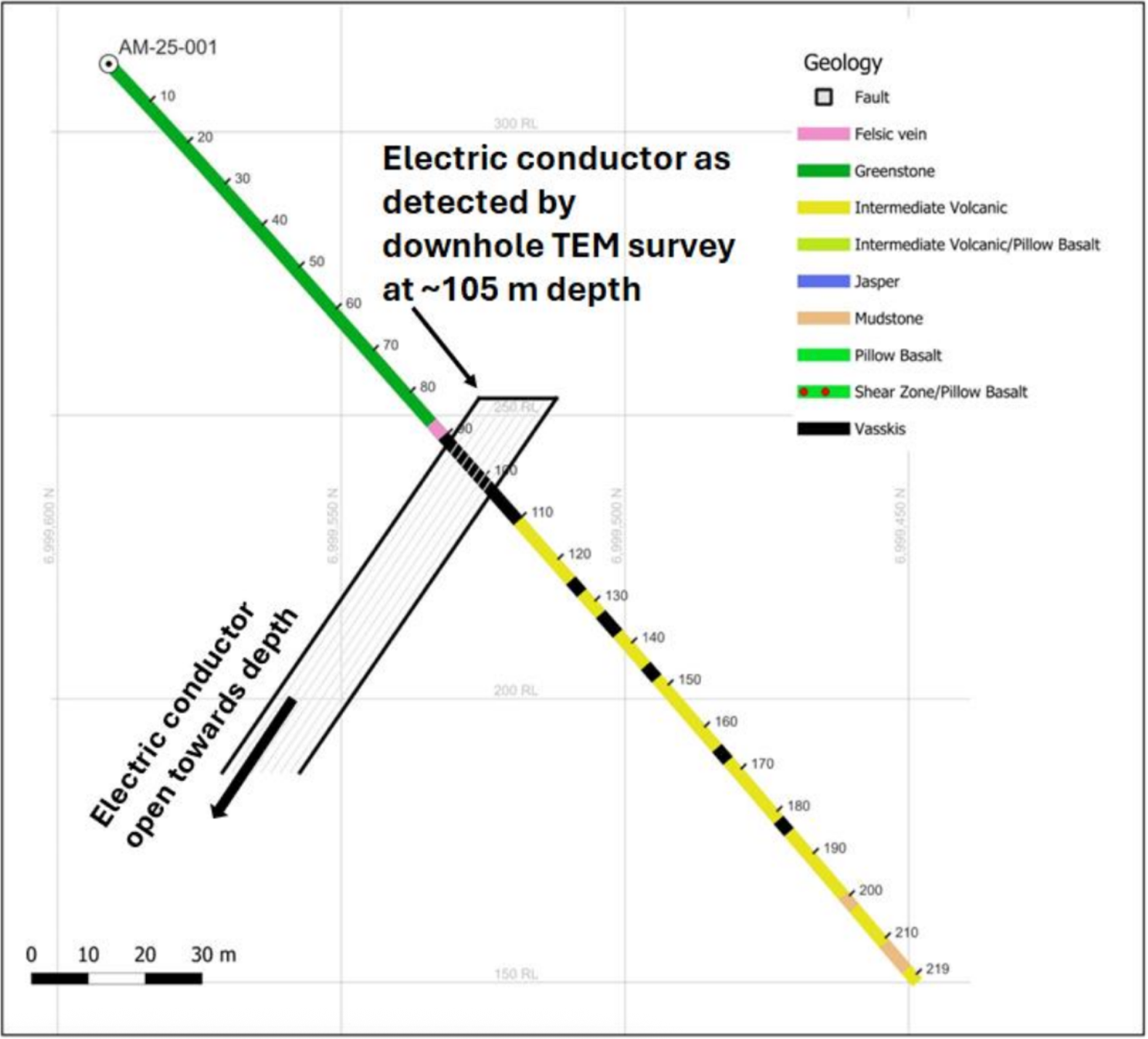
1 Historic production values quoted for Løkken are from Grenne T, Ihlen PM, Vokes FM (1999) Scandinavian Caledonide metallogeny in a plate-tectonic perspective. Mineral Deposita 34:422–471. Teako has not performed sufficient work to verify the published data reported above, but the Company believes this information to be considered reliable and relevant.
The Høydal Target Høydal drill hole HOY-25-001 was designed to test a surface geochemical Cu anomaly in an undrilled area, seeking the potential Cu-rich section of the Høydal stratigraphy that remains unidentified. To date, mineralization identified within the Høydal area has been mostly Zn dominated. HOY-25-001 was completed totaling 145.6 m and notably intersected a 4.9 m thick jasper bed from 68.2 m to 73.1 m (see Picture 2) which is, to the knowledge of the Company, among one of the thickest jasper beds discovered in the region. Historically in the Løkken district, jasper is known to be proximal to VMS-style mineralization. Mineralization intersected consists of minor vasskis-style units and weak disseminated pyrite mineralization. The lithologies and textures identified relate well to the known literature of the area. At around 27-37 m the geology is variable with deformed pillows and clasts containing jasper. This texture may relate to the talus horizons identified historically in the stratigraphy around Høydal.
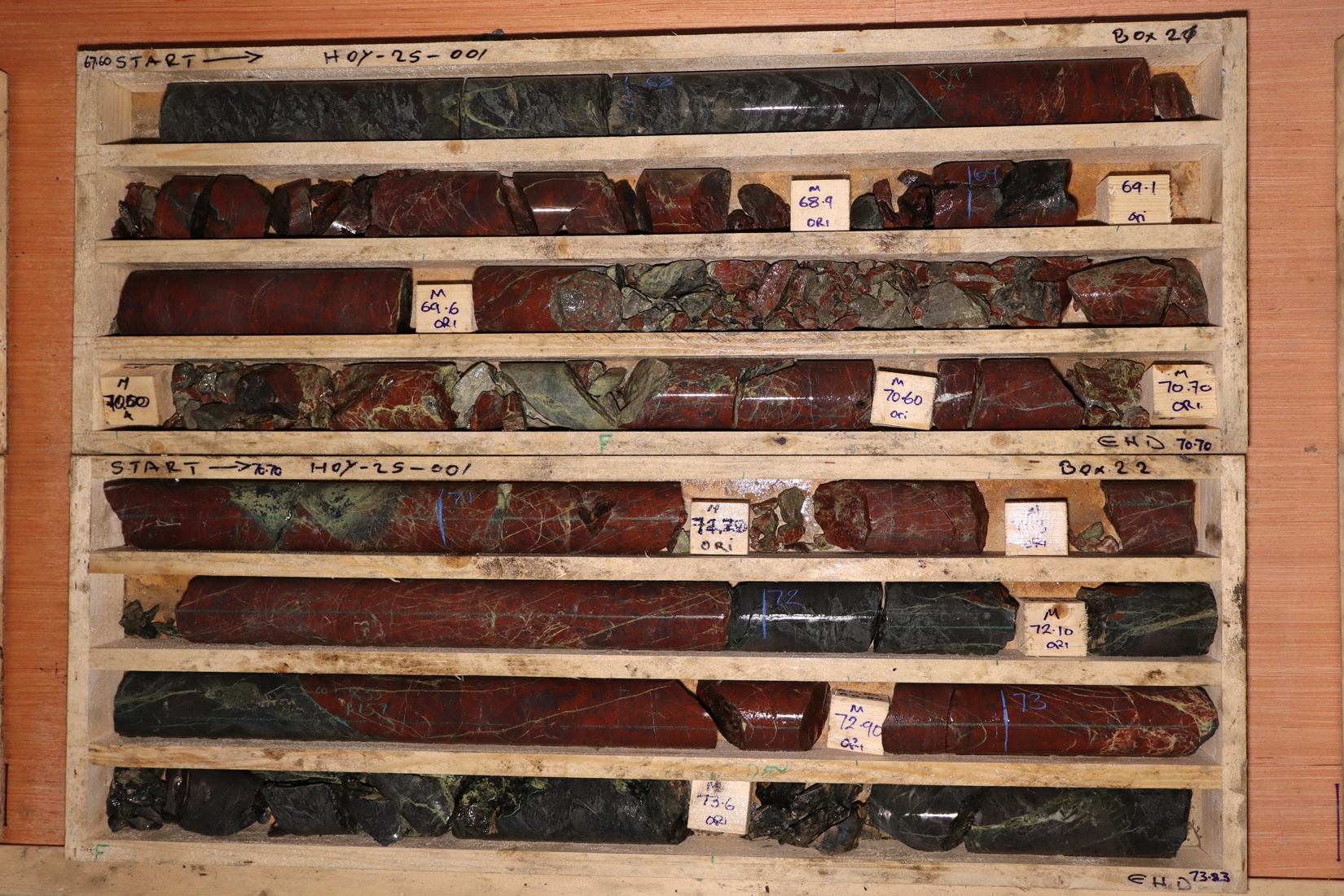
The highest density and the greatest thickness of jasper beds occur at the same stratigraphic level as the Løkken and Høydal ore bodies. The sulfide-jasper relationships are well exposed at Høydal, where jasper beds up to 5 m thick rest either directly on top of VMS deposits or on a reworked sulfide-jasper-basalt debris flow deposit (see Figure 3).
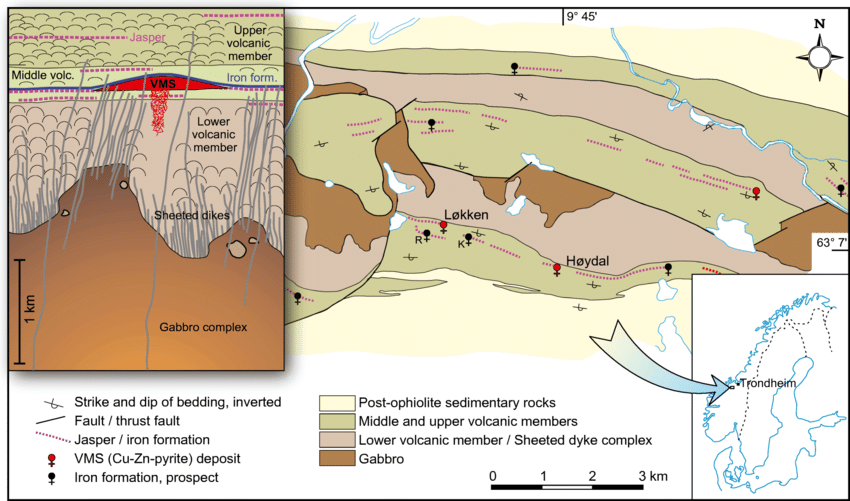
The DHEM survey undertaken at HOY-25-001 identified a below-hole conductive body, modeled to be situated approximately 30-40 meters below the end of hole. This conductor remains untested by drilling (see Figure 4), and extending HOY-25-001 is recommended to intersect this EM signature.
2 Grenne, T. & Slack, J.F. 2018. “Mineralogy and geochemistry of silicate, sulfide, and oxide iron formations in Norway: evidence for fluctuating redox states of early Paleozoic marine basins. Mineralium Deposita.”
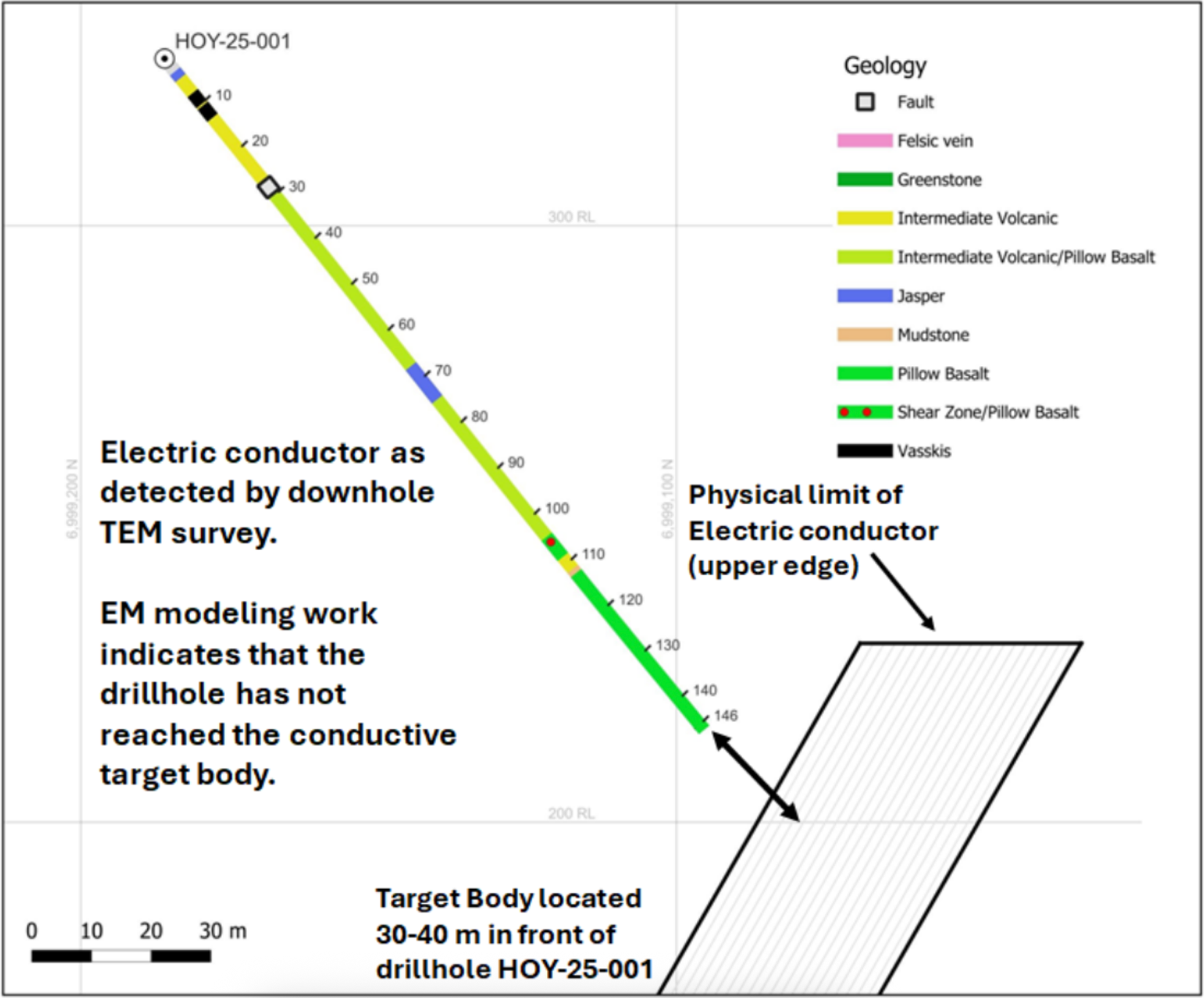
Qualified Person The technical information in this press release relating to the Løkken project has been prepared in accordance with Canadian regulatory requirements as set out in National Instrument 43-101 (“NI 43-101”) Standards of Disclosure for Mineral Projects, and reviewed and approved by Eric Roth, a Non-Executive Director of Teako and Qualified Person under NI 43- 101. Mr. Roth holds a Ph.D. in Economic Geology from the University of Western Australia, is a Fellow of the Australian Institute of Mining and Metallurgy (AusIMM), and is a Fellow of the Society of Economic Geologists. Mr. Roth has over 35 years of experience in international minerals exploration and mining project evaluation.
About Teako Minerals Corp.
Teako Minerals Corp. is a Vancouver-based mineral exploration company committed to acquiring, exploring, and developing mineral properties in Norway, focusing on critical metals such as copper, cobalt, zinc and molybdenum. By leveraging leading-edge exploration technologies and strategic partnerships, Teako aims to address the growing demand for essential minerals while generating value for shareholders and stakeholders alike.
Contact Information:
Sven Gollan – CEO T: +1 (604)-871-4301 Email: sven.gollan@teakominerals.com
Forward-Looking Information:
This press release may include forward-looking information within the meaning of Canadian securities legislation, concerning the business of Teako. Forward-looking information is based on certain key expectations and assumptions made by the management of Teako. In some cases, you can identify forward-looking statements by the use of words such as “will,” “may,” “would,” “expect,” “intend,” “plan,” “seek,” “anticipate,” “believe,” “estimate,” “predict,” “potential,” “continue,” “likely,” “could” and variations of these terms and similar expressions, or the negative of these terms or similar expressions. Although Teako believes that the expectations and assumptions on which such forward-looking information is based are reasonable, undue reliance should not be placed on the forwardlooking information because Teako can give no assurance that they will prove to be correct. Since forward-looking statements address future events and conditions, by their very nature, they involve inherent risks and uncertainties. Actual results could differ materially from those currently anticipated due to a number of factors and risks. These include but are not limited to, risks associated with the mineral exploration industry in general (e.g., operational risks in development, exploration and production; the uncertainty of mineral resource estimates; the uncertainty of estimates and projections relating to production, costs and expenses, and health, safety and environmental risks), constraint in the availability of services, commodity price and exchange rate fluctuations, changes in legislation impacting the mining industry, adverse weather conditions and uncertainties resulting from potential delays or changes in plans with respect to exploration or development projects or capital expenditures. These and other risks are set out in more detail in Teako’s interim Management’s Discussion and Analysis, for the period ended October 31, 2024.
All dollar figures included herein are presented in Canadian dollars, unless otherwise noted. Neither the CSE nor its market regulator accepts responsibility for the adequacy or accuracy of this press release.
400-601 West Broadway, Vancouver, BC, V5Z 4C2 TEL +1 (604)-871-4301 www.teakominerals.com
Not for dissemination in the United States or distribution through U.S. newswires
Teako Commences Maiden Diamond Drill Program at the Løkken Copper-Cobalt-Zinc Project, Norway
VANCOUVER, B.C. | March 20, 2025 | Teako Minerals Corp. (CSE: TMIN) (the “Company” or “Teako”) is pleased to announce that it has commenced a maiden diamond drill program on part of its district-scale Løkken copper-cobalt-zinc (“Cu-Co-Zn”) project in central Norway. Initial drilling will focus on the Åmot massive sulfide (“VMS”) target which lie immediately to the east of the former mining operations at the world-class Løkken copper-rich VMS deposit. The Åmot target is the first of five priority target areas defined within the Løkken concessions in which the Company acquired a 90% ownership interest from Capella Minerals Ltd. (TSXV: CMIL) in August, 2024 (see Company News Release dated August 19, 2024) (Figures 1 & 2). Highlights
- Teako has initiated a maiden diamond drill program at the Åmot VMS Cu-Co-Zn target, Løkken project, central Norway. • The Åmot target is a 2km-long geophysical (coincident electromagnetic and ground magnetic anomalies) and geochemical anomaly – all considered to be key indicators for “buried” VMS targets – and which has been defined by modern exploration techniques undertaken since the closing of the former Løkken mining operations in the mid- 1980’s. No drilling has yet been undertaken on the Åmot target. • The Company received all approvals for this current round of drilling the Åmot target in December, 2024, with the main limitation being that it be completed by March 31, 2025 (the expected end of winter conditions). Additionally, the Company has been granted an eleven (11) day extension (until April 11, 2025) to its drill permit at the Høydal target. The drill program will consist of a minimum of 580 meters and test the Åmot target, a copper-cobalt-zinc target located 5km East of the former Løkken mining operations and the first of many targets to be tested on the district scale project. Åmot is hosted within stratigraphy considered favourable for the discovery of further Løkken-type VMS deposits. The primary target is a large (up to 2km in length) coincident electromagnetic (EM), ground magnetic, and geochemical anomaly, which together represent a highly favourable combination for a buried VMS deposit (see Figure 1). The Åmot target is interpreted by the Company from a Maxwell plate modelling exercise of geophysical data to lie approximately 44.1m to 140.3m below the surface and has never been drill-tested. Additionally, the Company has been granted an eleven (11) day extension (until April 11, 2025) to its drill permit at the Høydal target. Drilling at this target will be subject to available time and weather.
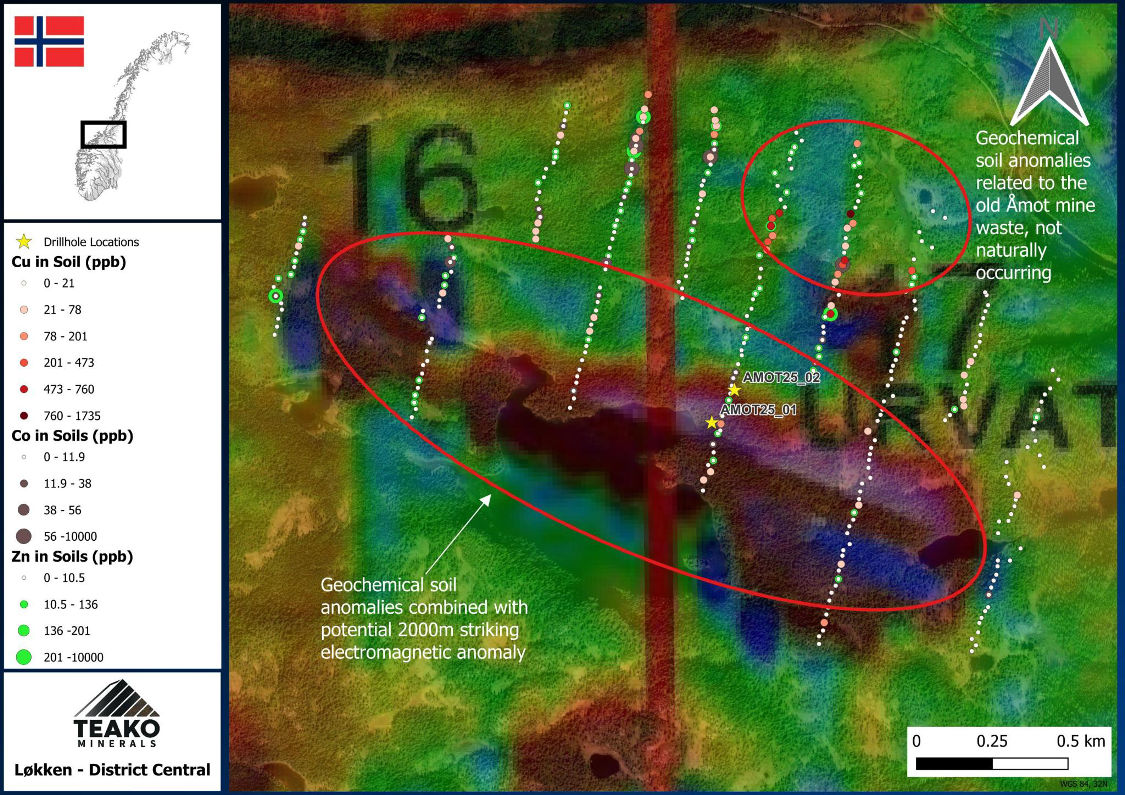
The Løkken Project The part of the district scale Løkken project in which the Åmot target is situated covers an area of 114 sq. km (90% owned by Teako)(see Figure 2), compliments Teako’s 100% Løkken claims, and surrounds the former Løkken underground copper mine, which closed in 1986 in response to low copper prices. The former Løkken mine is considered to be one of the largest ophiolite-hosted Cyprus-type VMS deposits (by tonnage) to have been developed in the world, producing an estimated 24Mt @ 2.3% Cu and 1.9% Zn (plus silver and gold credits)1,2. The former Løkken mine is a stratiform massive sulfide deposit characterized by its impressive dimensions – approximately 4 km in length, a maximum depth of 1 km, and an average thickness of 60 meters. Its rich mineral composition predominantly consisted of chalcopyrite, sphalerite, pyrite, and pyrrhotite. The Løkken deposit was discovered from a subtle massive sulfide outcrop, which measured less than 1m in width. The 90% owned Løkken claim block covers a significant portion of the old Løkken mine infrastructure (shafts, historical mineral processing facilities, railway loading area for concentrate, etc.), in addition to multiple satellite occurrences of copper-rich VMS mineralization with varying degrees of development. Given the geological propensity of these deposits to occur in clusters, Teako believes there is a high likelihood of additional undiscovered deposits within the district.
1 Historic production values quoted for Løkken are from Grenne T, Ihlen PM, Vokes FM (1999) Scandinavian Caledonide metallogeny in a plate-tectonic perspective. Mineral Deposita 34:422–471. Teako has not performed sufficient work to verify the published data reported above, but the Company believes this information to be considered reliable and relevant.
2 References made to adjacent mines/projects provide context for Teako’s projects but are not indicative that the projects host similar tonnages or grades of copper, zinc, or cobalt.
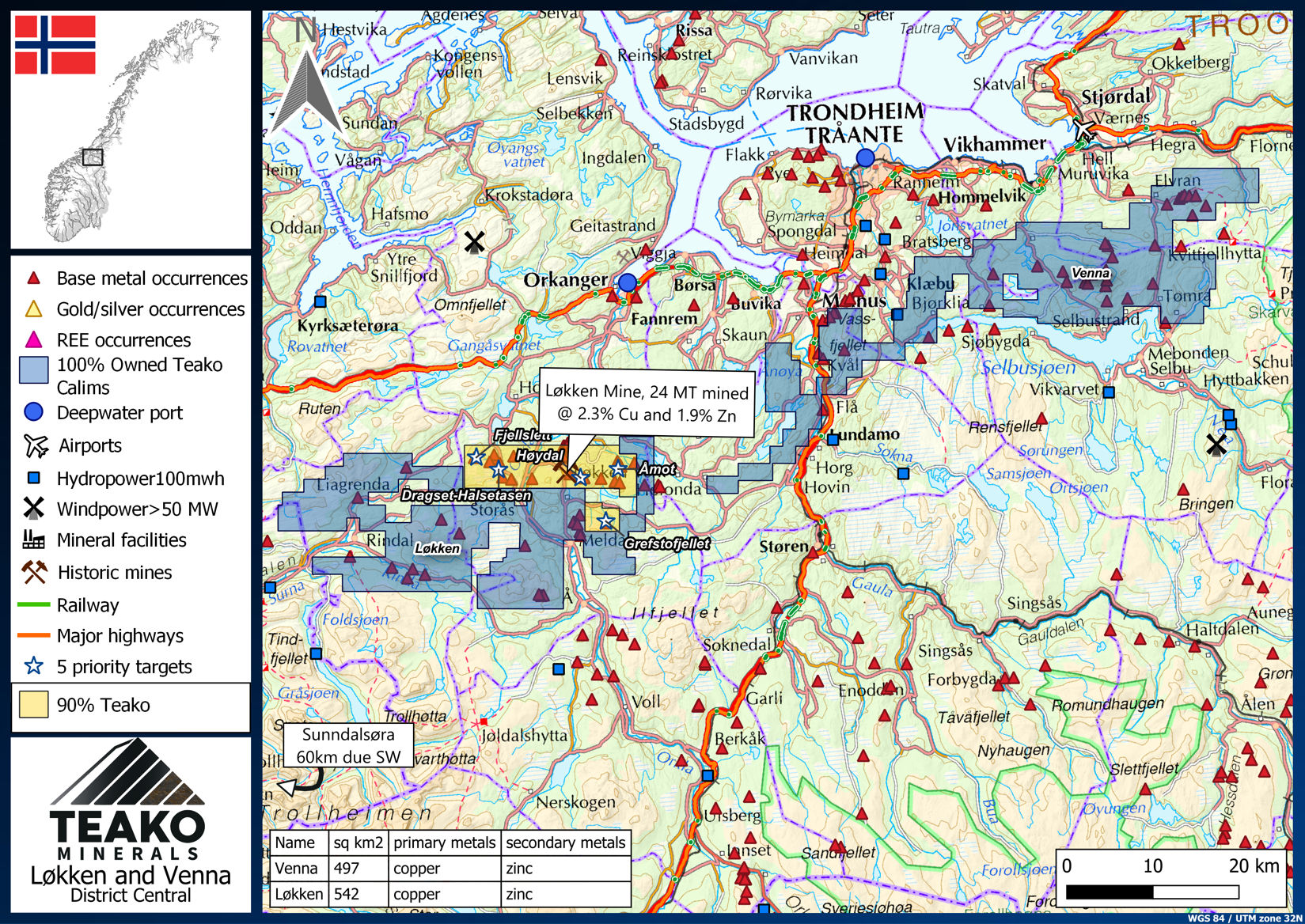
Qualified Persons and Disclosure Statement The technical information in this press release relating to the Løkken project has been prepared in accordance with Canadian regulatory requirements as set out in National Instrument 43-101 (“NI 43-101”) Standards of Disclosure for Mineral Projects, and reviewed and approved by Eric Roth, a Non-Executive Director of Teako and Qualified Person under NI 43- 101. Mr. Roth holds a Ph.D. in Economic Geology from the University of Western Australia, is a Fellow of the Australian Institute of Mining and Metallurgy (AusIMM), and is a Fellow of the Society of Economic Geologists. Mr. Roth has over 35 years of experience in international minerals exploration and mining project evaluation.
About Teako Minerals Corp.
Teako Minerals Corp. is a Vancouver-based mineral exploration company committed to acquiring, exploring, and developing mineral properties in Norway, focusing on critical metals such as copper, cobalt, zinc and molybdenum. By leveraging leading-edge exploration technologies and strategic partnerships, Teako aims to address the growing demand for essential minerals while generating value for shareholders and stakeholders alike.
Contact Information:
Sven Gollan – CEO T: +1 (604)-871-4301 Email: sven.gollan@teakominerals.com
Forward-Looking Information:
This press release may include forward-looking information within the meaning of Canadian securities legislation, concerning the business of Teako. Forward-looking information is based on certain key expectations and assumptions made by the management of Teako. In some cases, you can identify forward-looking statements by the use of words such as “will,” “may,” “would,” “expect,” “intend,” “plan,” “seek,” “anticipate,” “believe,” “estimate,” “predict,” “potential,” “continue,” “likely,” “could” and variations of these terms and similar expressions, or the negative of these terms or similar expressions. Forward-looking statements in this press release include statements related to i) meterage of expected drilling. Although Teako believes that the expectations and assumptions on which such forward-looking information is based are reasonable, undue reliance should not be placed on the forward-looking information because Teako can give no assurance that they will prove to be correct. Since forward-looking statements address future events and conditions, by their very nature, they involve inherent risks and uncertainties. Actual results could differ materially from those currently anticipated due to a number of factors and risks. These include but are not limited to, risks associated with the mineral exploration industry in general (e.g., operational risks in development, exploration and production; the uncertainty of mineral resource estimates; the uncertainty of estimates and projections relating to production, costs and expenses, and health, safety and environmental risks), constraint in the availability of services, commodity price and exchange rate fluctuations, changes in legislation impacting the mining industry, adverse weather conditions and uncertainties resulting from potential delays or changes in plans with respect to exploration or development projects or capital expenditures. These and other risks are set out in more detail in Teako’s interim Management’s Discussion and Analysis, October 31, 2024.
All dollar figures included herein are presented in Canadian dollars, unless otherwise noted. Neither the CSE nor its market regulator accepts responsibility for the adequacy or accuracy of this press release.
400-601 West Broadway, Vancouver, BC, V5Z 4C2 TEL +1 (604)-871-4301 www.teakominerals.com
Project in Norway; Permits Granted Within Two Weeks of Application VANCOUVER, B.C. | December 4, 2024 | Teako Minerals Corp. (CSE: TMIN) (the “Company” or “Teako”) is pleased to announce that it has been granted final permits for a winter helicopter-supported diamond drill program on its high-grade copper-cobalt-zinc Volcanogenic Massive Sulfide (or “VMS”) Løkken project (the “Project”). The Company recently acquired a 90% interest in the Løkken project from Capella Minerals Ltd (TSXV:CMIL)(see Company press release dated August 19, 2024). Teako applied for the Løkken drill permits on November 20, 2024 and these were subsequently granted on December 3, 2024. The permits cover a total of 19 diamond drill holes and for a winter drill program that must be completed by March 31, 2025. The drill holes consist of 5 priority drill holes on the Åmot target designed to test an EM anomaly not previously investigated with drilling and 4 priorty drill holes on the Høydal target designed to confirm historical mineralization and assess the western extension of a previously identified mineralized trend, as well as to investigate a potential second mineralized structure. In addition, the permit is also valid for a further 6 infill/step out drill holes on Åmot and 4 infill/step out drill holes on Høydal which the Company has designed to expand the drill program if it chooses to. The Åmot top of target has recently been interpreted from a Maxwell plate modelling exercise to lie at significantly shallower depths than the previously reported (within the press release August 19, 2024) 150m; it is now believed to lie approximately 44.1m to 140.3m below the surface and has never been drill-tested. Åmot represents one of the highest-priority drill targets on the Løkken property. Similarly from the Maxwell plate modelling exercise, the Høydal top of target is interpreted to lie approximately 27.5m to 130.6m below the surface. The Company is in contact with drill contractors and expects to commence drilling operations, at the Åmot target, and potentially the Høydal target, in early 2025. Execution of the drill program is subject to financing and depends, in part, on the Company successfully closing the second and final tranche of its open private placement (see Company press release dated November 19, 2024). The Åmot & Høydal Targets The Åmot Cu-Co-Zn target is located 5km East of the former Løkken mining operations. It is hosted within stratigraphy considered favourable for the discovery of further Løkken-type massive sulfide (VMS) deposits. The primary target is a large (up to 2km in length) coincident electromagnetic (EM), ground magnetic, and geochemical anomaly, which together represent a highly favourable combination for a buried VMS deposit. The Høydal Cu-Co-Zn target lies immediately to the East of the former Løkken mining operations and within the highly prospective Løkken-Høydal-Åmot corridor. The primary target at Høydal is a 3 km-long corridor containing Cu-Zn-rich VMS-style mineralization with approximately 1 km of this corridor being previously tested by historical core drilling.
About The Løkken Project The Løkken concessions span 542 sq. km, with 428 sq. km of this area being 100% owned by Teako. These surround the historic Løkken copper-zinc mine to the south and west. The remaining 114 sq. km of the Løkken concessions (see highlighted in yellow, Figure 1), which include the Løkken mine itself, the Åmot and Høydal targets as well as 3 additional targets (Figure 2), are 90% owned by Teako, with Capella Minerals holding a 10% interest. The primary target types at the Løkken project are high-grade copper-cobalt-zinc massive sulfide (“VMS”) deposits. The Løkken project is located approximately 50km SW and 30km SE, respectively, of the regional administrative centre of Trondheim, Trøndelag Province, central Norway. Løkken also covers the former Løkken mining district (reported historical production of 24MT @ 2.3% Cu + 1.9% Zn plus silver and gold credits1). The former Løkken mine is considered to be one of the largest ophiolite-hosted Cyprus-type VMS deposits (by tonnage) to have been developed in the world. The Løkken claim block covers a significant portion of the old Løkken mine infrastructure (shafts, historical mineral processing facilities, railway loading area for concentrate, etc.), in addition to multiple satellite occurrences of copper-rich VMS mineralization with varying degrees of development. The former Løkken mine is a stratiform massive sulfide deposit characterized by its impressive dimensions – approximately 4 km in length, a maximum depth of 1 km, and an average thickness of 60 meters. Its rich mineral composition predominantly consisted of chalcopyrite, sphalerite, pyrite, and pyrrhotite. Given the geological propensity for these deposits to occur in clusters, there is a high likelihood of additional undiscovered deposits within the broader district. The Løkken deposit was discovered from a subtle massive sulfide outcrop measuring less than 1m in width. The proximity of the Løkken claims to the former Løkken mine places the Company in an advantageous position to explore potential extensions of this prolific deposit.
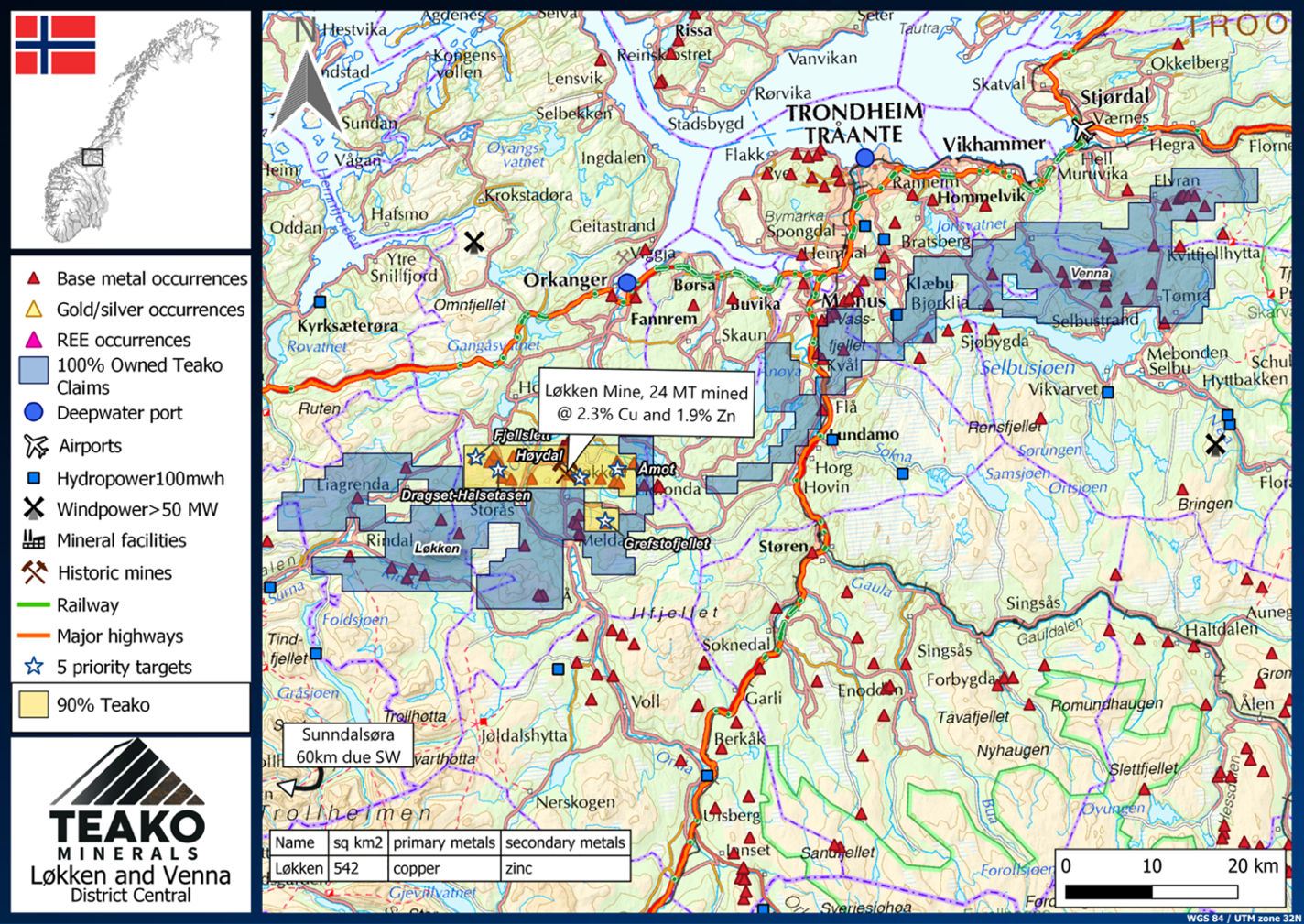
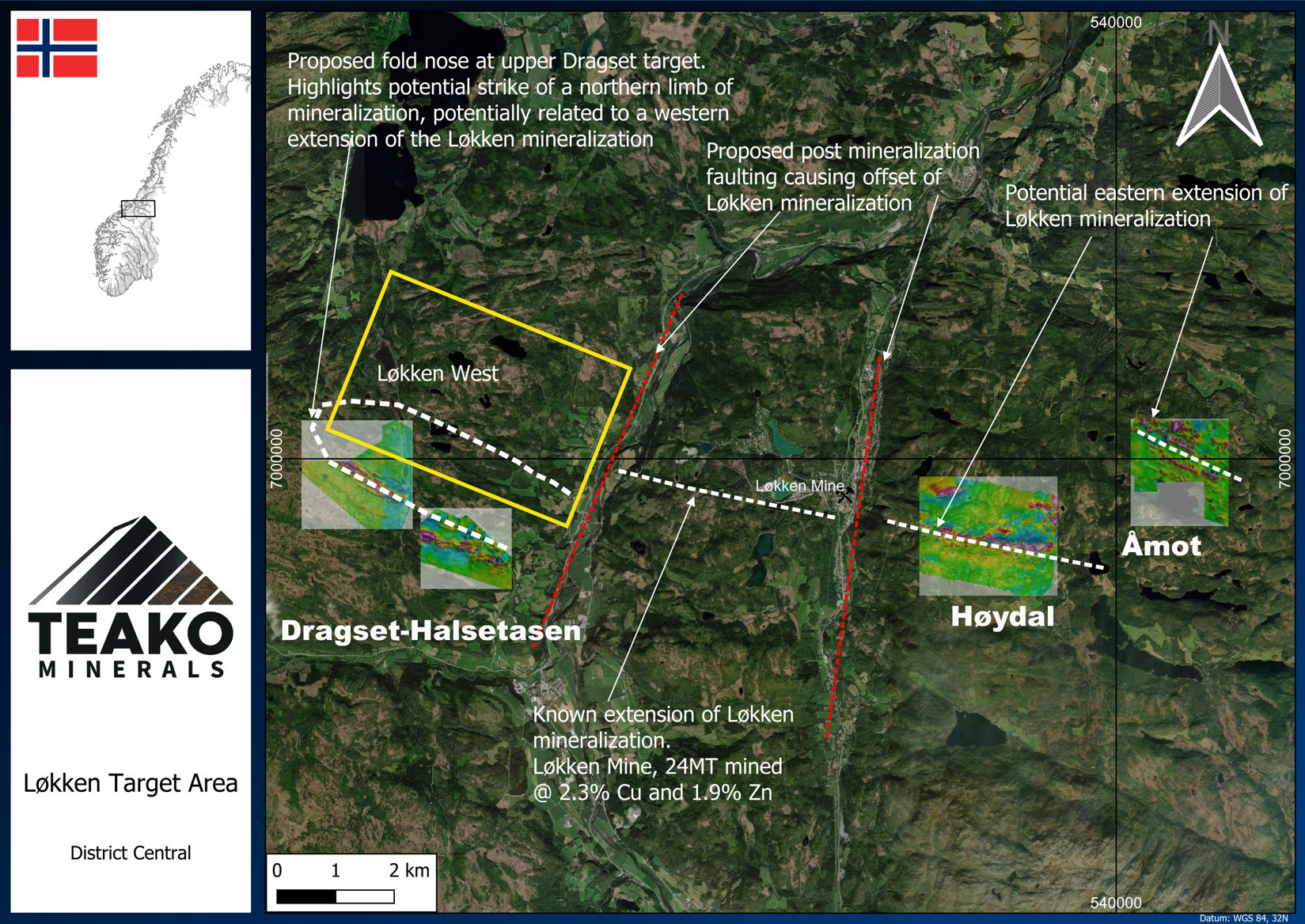
1 Historic production values quoted for Løkken are from Grenne T, Ihlen PM, Vokes FM (1999) Scandinavian Caledonide metallogeny in a plate-tectonic perspective. Mineral Deposita 34:422–471, TMIN has not performed sufficient work to verify the published data reported above, but the Company believes this information to be considered reliable and relevant. Special Advisor The Company is also pleased to welcome special advisor Mrs. Hege Tunstad to its team. Mrs. Hege is a neuroscience expert and strategist with over 20 years of experience in academia and the private sector. Hege specializes in helping leaders and organizations develop and achieve their goals by applying insights from neuroscience and holds a Master of Science in Neuroscience from the Norwegian University of Science and Technology (NTNU) and has additional education in applied neuroscience for business purposes from Wharton. Her career includes prominent roles at NTNU, the Confederation of Norwegian Enterprise (NHO), and the Kavli Institute for Systems Neuroscience. Tunstad’s expertise lies in strategic communication, leadership development, and building collaborative networks.
Hege is skilled in identifying key trends, crafting compelling messages, and navigating complex discussions. Her work at NHO, where she served as a Senior Advisor, included leading a project to foster collaboration among businesses and organizations relevant to the mining industry. This initiative led her to establish a network that includes individuals and organizations within the mining sector, as well as members of the Sami community, who often have deep ties to the land where mining operations take place. This experience positions her uniquely to understand the multifaceted dynamics of the mining industry in Norway, including its social, economic, and environmental dimensions. Her background in neuroscience provides her with a unique perspective on fostering understanding and collaboration in settings where diverse stakeholders and interests converge. Qualified Person The disclosure of technical information in this press release has been prepared in accordance with Canadian regulatory requirements as set out in National Instrument 43-101 Standards of Disclosure for Mineral Projects, and reviewed and approved by Eric Roth, Non-Executive Director of Teako, who acts as the Company’s qualified person and is not independent of the Company. Historical references from publicly available reports represent unverified data but are considered adequate for exploration purposes. About Teako Minerals Corp.:
Teako Minerals Corp. is a Vancouver-based mineral exploration company committed to acquiring, exploring, and developing mineral properties in Norway for copper, cobalt, zinc and molybdenum. The adoption of technologies such as the SCS Exploration Product aligns with its strategy to remain at the forefront of the rapidly evolving mining industry.
Contact Information
Sven Gollan – CEO T: +1 (604)-871-4301 Email: sven.gollan@teakominerals.com
Forward-Looking Information:
This press release may include forward-looking information within the meaning of Canadian securities legislation, concerning the business of Teako. Forward-looking information is based on certain key expectations and assumptions made by the management of Teako. In some cases, you can identify forward-looking statements by the use of words such as “will,” “may,” “would,” “expect,” “intend,” “plan,” “seek,” “anticipate,” “believe,” “estimate,” “predict,” “potential,” “continue,” “likely,” “could” and variations of these terms and similar expressions, or the negative of these terms or similar expressions. Although Teako believes that the expectations and assumptions on which such forward-looking information is based are reasonable, undue reliance should not be placed on the forward-looking information because Teako can give no assurance that they will prove to be correct. Since forward-looking statements address future events and conditions, by their very nature, they involve inherent risks and uncertainties. Actual results could differ materially from those currently anticipated due to a number of factors and risks. These include but are not limited to, risks associated with the mineral exploration industry in general (e.g., operational risks in development, exploration and production; the uncertainty of mineral resource estimates; the uncertainty of estimates and projections relating to production, costs and expenses, and health, safety and environmental risks), constraint in the availability of services, commodity price and exchange rate fluctuations, changes in legislation impacting the mining industry, adverse weather conditions and uncertainties resulting from potential delays or changes in plans with respect to exploration or development projects or capital expenditures. These and other risks are set out in more detail in Teako’s interim Management’s Discussion and Analysis, July 31, 2024.
All dollar figures included herein are presented in Canadian dollars, unless otherwise noted. Neither the CSE nor its market regulator accepts responsibility for the adequacy or accuracy of this press release.
400-601 West Broadway, Vancouver, BC, V5Z 4C2 TEL +1 (604)-871-4301 www.teakominerals.com
Not for dissemination in the United States or distribution through U.S. newswires
Teako Closes First Tranche of its Previously Announced Non-Brokered Private Placement and Closes
Definitive Agreement to Acquire Majority Interest in Løkken Project
VANCOUVER, B.C. | August 29, 2024 | Teako Minerals Corp. (CSE: TMIN) (the “Company” or “Teako”) is pleased to announce that it has closed the first tranche of its previously announced non-brokered private placement (the “Offering”), by issuing 4,545,433 common shares (“Common Shares”) in the capital of the Company for aggregate gross proceeds of approximately $409,090 (the “First Tranche”). Concurrently with closing of the First Tranche, the Company has paid CAD$350,000 in cash and issued 2,500,000 Common Shares to Capella Minerals Ltd. (TSXV: CMIL)(“Capella”) in connection with the definitive agreement (the “Agreement”), under which Teako has now acquired a 90% ownership interest in the drill-ready Løkken project in Trøndelag, Norway (the “Project”), all as announced on August 19, 2024.
Further, the Company announces the issuance of 400,000 Common Shares to Fruchtexpress Grabher GmbH & Co KG (“FEx”) pursuant to a loan agreement dated August 25, 2023 (the “Loan”). The Company also announces the intended closure of Teako Finland and a minor correction to the press release dated August 19, 2024.
The Private Placement
Under the First Tranche of the Offering, the Company issued 4,545,433 Common Shares at a price of CAD$0.09 per Common Share for aggregate gross proceeds of CAD$409,090. The Company did not pay any finder’s fees in cash or securities under the First Tranche. Closing of the second and final tranche of the Offering is anticipated to occur on or about September 30, 2024, and is subject to certain customary conditions, including, without limitation, approval of the Canadian Securities Exchange (the “CSE”).
The First Tranche was fully subscribed by existing and new shareholders from Denmark and Norway.
Chief Executive Officer, Sven Gollan, comments: “Teako is well-positioned to actively participate in the growing mineral exploration sector in Norway. This wouldn’t be possible without the continued support of our shareholders. We extend our gratitude to those who once again place their trust in us and join us in unlocking the untapped potential of Norway’s mineral wealth”.
In connection with the Offering, the Company may pay finder’s fees in cash or securities or a combination of both, as permitted by the policies of the CSE and applicable securities laws. All of the Common Shares issued under the Offering will be subject to a four-month and one-day statutory hold period.
The Company intends to use the net proceeds of the Offering to fund the cash consideration payable in connection with the Agreement and provide funding for drilling as well as general and administrative expenses.
The Common Shares offered have not been registered under the U.S. Securities Act of 1933, as amended (the “U.S. Securities Act”), or any applicable state securities laws and may not be offered or sold to, or for the account or benefit of, persons in the United States or “U.S. persons,” as such term is defined in Regulation S promulgated under the U.S. Securities Act, absent registration or an exemption from such registration requirements. This press release shall not constitute an offer to sell or the solicitation of an offer to buy, nor shall there be any sale of the Common Shares in any jurisdiction in which such offer, solicitation, or sale would be unlawful.
The Løkken Agreement
Under the terms of the Agreement, Teako was required to issue 2,500,000 Common Shares and pay CAD$350,000 in aggregate cash consideration to Capella on or before August 30, 2024.
In accordance with applicable securities laws, the Common Shares issued to Capella will be subject to a fourmonth and one-day statutory hold period. Additionally, the Common Shares issued to Capella are subject to contractual restrictions on transfer as follows: (i) 33% of the Common Shares are subject to a four-month restriction from the issue date; (ii) 33% of the Common Shares are subject to an eight-month restriction from the issue date; and (iii) the balance of the Common Shares are subject to a one-year restriction from the issue date.
Teako has agreed to the following exploration obligations on the Project: (i) completion of a drill program on the Åmot Target of the Project within 12 months of the Agreement, subject to drill permitting being confirmed; and (ii) completion of sufficient exploration work to develop a further two targets on the Project to drill-ready status within 24 months of the Agreement.
Teako Finland and Correction
The Company also announces that its board of directors has agreed to close its inactive subsidiary, Teako Finland. This decision reflects the Company’s continued focus on its core operations in Norway and the opportunities that lie ahead.
The Company has also just been made aware of a correction that is required to be made to its news release dated August 19, 2024. In the discussion surrounding historical drilling from the Høydal sector (Page 6), historical drill hole BH-83 was reported to have returned 3.07m @ 20.9% Cu. However, the news release should have stated that BH-83 returned 3.07m @20.9% Zn. Notwithstanding this, the Company’s strategy to confirm high copper and zinc grades in the Høydal sector through the twinning of select historical holes remains unchanged.
The Shareholder Loan
On August 25, 2023, the Company closed a Shareholder Loan with FEx, whereby it received proceeds of CAD$750,000. By its terms, the Shareholder Loan has a five-year term and bears interest at 4% per annum, calculated monthly and compounded annually, with interest repayable annually in Common Shares.
Pursuant to the Shareholder Loan, the Company issued 400,000 Common Shares to FEx at a price of CAD$0,075 per Common Shares, fully satisfying the annual interest payment due thereunder.
Share Structure Update
Following the above share issuance, the number of issued and outstanding Common Shares of the Company is now 79,045,241 with 988,000 warrants and 975,000 stock options outstanding which brings the fully diluted share count to 81,008,241.
About Teako Minerals Corp.
Teako Minerals Corp. is a Vancouver-based mineral exploration company committed to acquiring, exploring, and developing mineral properties in Norway for copper, cobalt, gold, molybdenum, and rare earth elements. The adoption of technologies such as the SCS Exploration Product aligns with its strategy to remain at the forefront of the rapidly evolving mining industry.
Contact Information
Sven Gollan – CEO T: +43 5522 500429 Email: sven.gollan@teakominerals.com
Forward-Looking Information:
This press release may include forward-looking information within the meaning of Canadian securities legislation, concerning the business of Teako. Forward-looking information is based on certain key expectations and assumptions made by the management of Teako. In some cases, you can identify forward-looking statements by the use of words such as “will,” “may,” “would,” “expect,” “intend,” “plan,” “seek,” “anticipate,” “believe,” “estimate,” “predict,” “potential,” “continue,” “likely,” “could” and variations of these terms and similar expressions, or the negative of these terms or similar expressions. Forward-looking statements in this press release include (i) expectations regarding the characteristics, value drivers, and anticipated benefits of the Project; (ii) expectations regarding the Company’s financing plans, closing times, receipt of regulatory approvals, and future development opportunities in connection with the Offering and the Project; (iii) expectations regarding the Offering and the timing and closings thereof; (iv) expectations regarding the use of proceeds of the Offering; and (vi) expectations concerning the Company’s business plans and operations. Although Teako believes that the expectations and assumptions on which such forward-looking information is based are reasonable, undue reliance should not be placed on the forward-looking information because Teako can give no assurance that they will prove to be correct. Since forward-looking statements address future events and conditions, by their very nature, they involve inherent risks and uncertainties. Actual results could differ materially from those currently anticipated due to a number of factors and risks. These include but are not limited to, risks associated with the mineral exploration industry in general (e.g., operational risks in development, exploration and production; the uncertainty of mineral resource estimates; the uncertainty of estimates and projections relating to production, costs and expenses, and health, safety and environmental risks), constraint in the availability of services, commodity price and exchange rate fluctuations, changes in legislation impacting the mining industry, adverse weather conditions and uncertainties resulting from potential delays or changes in plans with respect to exploration or development projects or capital expenditures. These and other risks are set out in more detail in Teako’s annual Management’s Discussion and Analysis, January 31, 2024.
All dollar figures included herein are presented in Canadian dollars, unless otherwise noted. Neither the CSE nor its market regulator accepts responsibility for the adequacy or accuracy of this press release.
400-601 West Broadway, Vancouver, BC, V5Z 4C2 TEL +1 (604)-871-4301 www.teakominerals.com